Showing posts with label food. Show all posts

Saturday, February 25, 2012

Morioka Ja Ja Men

Morioka city is famous for three type of noodles -- Wanko Soba, Morioka Reimen, and Morioka Ja Ja Men.  The Ja Ja Men was originally invented by Kansho Takashina after he came back to Morioka from Manchuria.  He started his business selling dumplings at a stand, but he missed his favorite noodles that he had eaten in Manchuria, and so around 1953, he perfected his noodle dish which became known as Morioka Ja Ja Men.

Food is always on our mind, and we are continuously thinking about where and what to eat for lunch and dinner.  On this leg of our trip, we were thinking about having lunch on the Shinkansen or in Tokyo when we left the Tsurunoyu Onsen at 8am to head back to Tokyo.  When we got to the Tazawako Station in Akita that morning, we were told that the 10am train was not running due to snow near Akita City.  Since we had to wait for a Shinkansen, our thoughts naturally turned to food.  

By the time we were able to board the Shinkansen, it was around 11:30am.  Crossing from west of the Ouu Mountain Range (奥羽山脈)to the east, going to Morioka City, all of the snow that had been the most dominant part of the landscape  seemed to melt away.  Cold air masses from the Asian continent dumps lots of snow on the western part of Tohoku and drys up when it reaches to eastern part.  When we arrived in Morioka, it was a little strange to see so little snow.

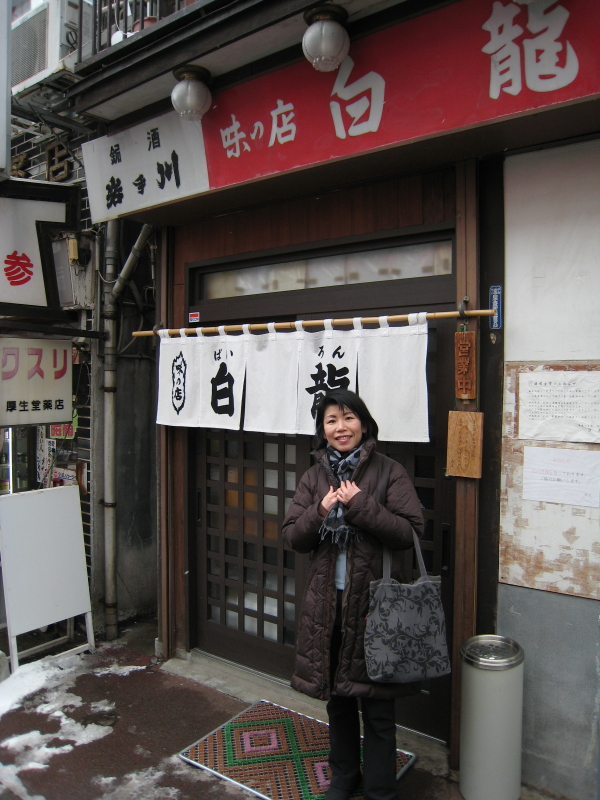
Now that we were in Morioka with time between trains, how could we miss the opportunity to sample one of great noodle dishes of Morioka?  With two hours til the next train, we bolted to the original Ja Ja Men shop, Pairon (白龍 ) near the Morioka Castle Ruins Park and City Hall.  It was during a lunch time when we arrived, and the shop was filled with salarymen working nearby.  It was a narrow,  hole-in-the-wall, with tables and counter sporting only the necessary chopsticks and condiments.  Salarymen were reading manga while they were waiting for their noodles.


We wasted no time ordering.  Delivered just as quickly, our bowls of Ja Ja Men were filled with white udon-like noodles topped with cucumbers and a mountain of ground pork and a special local miso on top, accompanied by grated ginger and pickles.  Noticing our cluelessness on how to eat it, the lady of the house came to the rescue and gave us a quick tutorial.  Reaching for the condiments, she added vinegar, grated garlic, and sesame oil, and quickly mixed the noodles with the miso, cucumbers, and ginger.

It was amazing!  Nothing seemingly special, yet so tasty, we still salivate when thinking about this unique dish.  The miso with ground pork was in perfect harmony with the udon-like noodle, vinegar and oil.  Many other salarymen came and went while we slowly savored each bite.

It wasn't over once we finished eating the noodles.  The lady then came to our table, picked up a raw egg on the table, cracked it open, added it to the dish, and brought the dish over to a man at the counter who was cooking the noodle.  He poured some hot water from noodle cooking pot into our bowls.  Our Ja Ja Men became an egg soup that blended perfectly with the mix of noodle, miso, and pork remaining in the bottom of the bowl. We finished drinking the soup and were left with nothing but a squeaky clean, a self cleaned dish!


Pairon
5-15 Uchimaru, Morioka, Iwate Prefecture
Japan
Phone:019-624-2247

Monday, November 21, 2011

Tsurunoyu Onsen

When one envisions the quintessential winter scene in the snow-covered mountains of Japan, it might also likely involve soaking in an onsen (hot spring) watching the snow falling quietly around you.  We had dreamed of  enjoying this very experience and so we sought the picture-perfect onsen for our trip to Akita in late January/early February.

While researching the subject using an onsen guide (convenient!), Hiroko was taken with the milky white water of the well-known Tsurunoyu Onsen.  The resort's ryokan (inn) had several rooms with a cooking hearth where your meal is cooked over glowing coals.  Tsurunoyu is one of the country's most famous onsen and therefore a very difficult reservation to secure. Hiroko actually called the onsen to make our reservation in the Spring of 2010!  Since we were going all the way to Akita, we wanted to stay in one of the more rustic rooms to enjoy the whole cooking-in-your-room experience.  Fortunately for us, Hiroko was able to reserve one of these rooms.


When we arrived at the ryokan, it was so dark that we couldn't really see much of our surroundings.  All we knew was that it was very cold and that we were in a place where there was more snow than we'd ever seen. 

The ryokan was old and rustic and known to be originally opened to the public during the Genroku period (1688-1704).  The roof of the main building is still made from straw and is replaced every 6 years!

The main attraction of the resort is milky water onsen.  After dinner in the room by the sunken hearth, we headed to a konyoku (coed) outdoor bath.  After you take off your clothes, you can wash and clean yourself in an adjacent indoor bath, then go outside to walk the path to the main bath.  When we were in onsen, it was snowing and cold.  The water was rather lukewarm, and we were getting too cold to be in the water.  We were joined by a number of other bathers but it was dark and with the rising steam we couldn't see much of them.  The water was very milky and soft, and it was a perfect setting to relax.

Next morning before the breakfast, we decided to soak more in onsen. This time there was no one else there...so quiet...with crisp air, and no snow, it was a relaxing morning bath.  

We explored the grounds of the ryokan after the breakfast since we hadn't been able to see much of anything the previous evening when we arrived.  The snow created an "authentic snow country vista" that was both beautiful and serene.  


Thursday, May 26, 2011

Wasabi Farm in Nagano


When Hiroko visited Miyasaka Brewery in Nagano, she made a side trip to Daio Wasabi Farm in Azumino, Nagano.  Wasabi is grown in the very clean water of mountain streams and many of us in the US have not seen real wasabi.  Most of us only know the wasabi that comes in a green tube that you buy from a grocery store (which is in fact,  not real wasabi).

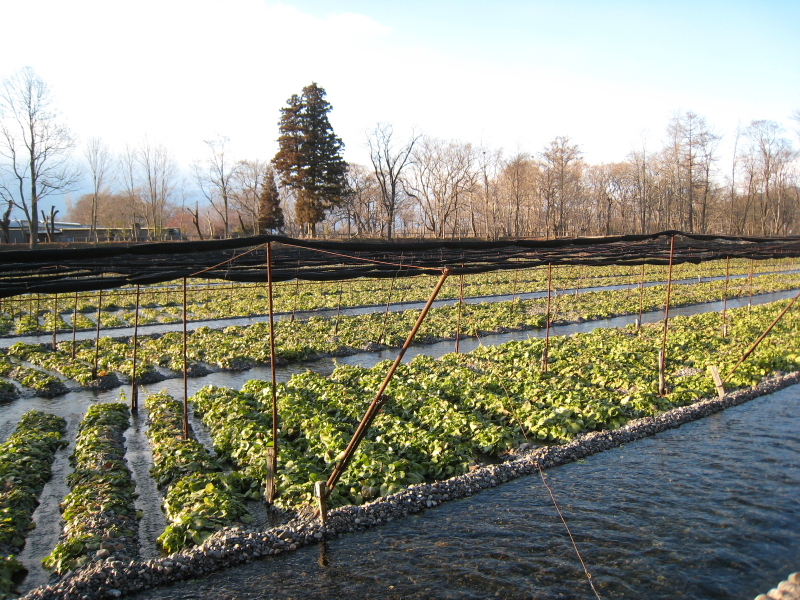
Daio Wasabi Farm is a family-oriented working farm, where you can watch the processing of wasabi, walk around to enjoy the beautiful scenic views, and eat soba or wasabi themed food including ice cream.  Opened in 1917, the farm is one of the largest wasabi farms in Japan. The farm is fed by constantly running underground water throughout that is kept at a temperature of 50 to 55 degrees Fahrenheit (12-14 degrees Celsius). The wasabi is planted in sand and pebble trenches which act like soil.  After allowing the plant two years of initial growth, it is ready for harvesting (removing one of the roots of the plant) year around.

It's hard to resist trying their wasabi ice cream. As Hiroko watched, a man at the service stand grated fresh wasabi and sprinkled it on wasabi soft serve ice cream.  The ice cream has a hint of wasabi flavor, and with the fresh wasabi it was a perfect combination of spicy and sweet! 

Wednesday, November 17, 2010

Homemade Pizza

After discovering  pizza dough at Whole Foods this year, we had made number of pizzas last summer using heirloom tomatoes.

Our pizza is nothing fancy.  We usually make two kinds of pizza.  One is basic fresh mozzarella, fresh basil, tomato, and sliced red onion.   The other one is a "creative" pizza, for which the toppings are fashioned from whatever ingredients are available in the refrigerator.

Pizza are quick and fun to make, and  goes great with white wine, red wine, and sake.  Here are some of our efforts...

Meat sauce and tomato and mozzarella varieties


Mushroom, broccoli, and caramelized onion;  tomato and mozzarella


Roasted fingering potatoes, portabello mushroom, red onion, and green beans;  tomato and mozzarella


Steamed broccoli, mushroom, and caramelized onion; tomato and mozzarella


Sauteed eggplant, broccoli, Chinese cabbage, caramelized red onion; tomato and mozzarella

Wednesday, June 02, 2010

Okome Milk


Recently, we had a visit at SAKAYA from Yageta-san from Fukumitsu-ya Brewery and he brought us an interesting Fukumitsu-ya product called Okome Milk that Hiroko wanted to try. It's made from rice, koji (koji mold affected rice), and water.  The product does not contain yeast, which is a necessary ingredient for making sake.  This Osake Milk has no yeast involved, so it hasn't been fermented and therefore has no alcohol content.  The flavor of Okome Milk is similar to amazake, which is traditional sweet low alcoholic drink. 

Fukumitsu-ya's Okome Milk has a cute package and there are four flavors including plain, strawberry, banana, and mango.  The product does not use any artificial colors or preservatives, is filled with lots of  nutrients including vitamins and nine kinds of amino acids.

When Hiroko spotted strawberries at farmer's market, she decided to make Okome Milk Strawberry slush.  After chilling it overnight in the freezer, she put the strawberry Okome Milk in the blender to made slushy texture.  Decorated with fresh strawberries, it made a delicious summer dessert.  

Friday, May 07, 2010

Sake Kasu Cheesecake


Last year, Kazuhiro Sakurai from Asahi Shuzo in Yamaguchi gave us his Dassai Junmai Ginjo sake kasu.  Sake kasu is the sake lees that are left over after the mash has been pressed to extract the sake following fermentation.  The kasu is filled with lots of nutritients including carbohydrates, proteins, vitamin B, fiber, and yeast, and has some valuable potential health benefit.  Traditionally, sake kasu has been used to make amazake, a sweet sake by mixing it with sugar and water.  Another use is to add it to miso soup or in making Japanese pickles.  Lately, we have also seen sake kasu used in cosmetics such as facial masks.  When we received the sake kasu from Mr. Sakurai, we made sake kasu nabe, mixing sake kasu with the soup in nabe (hot pot).  Adding the sake kasu enriches the flavor of the nabe adding another flavor dimension to an ordinary pork or chicken nabe.  We froze the left over sake kasu for  future use. 

Recently, Hiroko had the urge to bake something sweet.  Struck by a bolt of inspiration, she suddenly announced, "I am going to make a sake kasu cheesecake."  

She pulled the frozen sake kasu from the freezer to thaw the day before she was going to bake.  A 300g package contains two sheets of sake kasu.  We had one sheet remaining in the package. The first step was to break it into small pieces and mix it with warm milk to make a soft paste (about 1/2 cup).
While baking the crust, she mixed cream cheese, the sake kasu paste, and sugar together, and beat eggs into the mixture one at a time.  She then tasted the mixture and added lemon zest, lemon juice, and vanilla to adjust the flavor.  She then poured the  mixture into the baked crust, and baked it for about an hour.  

The kitchen was filled with the savory aroma of cheese and sake.  The next day, she sliced it gently to taste her creation.  It was very soft and moist, and it tasted almost like regular cheesecake, but sake flavor lingered long after each bite.  Paired  with a nigori zake, it made a delicious dessert.  


Sake Kasu Cheesecake

Ingredients:
crust:  
1/3 cup cookie crumbs
2 tablespoons melted butter

filling: 
2   8 ounce packages of softened cream cheese (Hiroko used 1/3 less fat) 
1/2 or less cup of softened sake kasu (sake kasu mixed with milk, soy milk, water, or sake)
3 eggs
1/2 cup sugar
1 lemon juice
Zest of 1 lemon
1 teaspoon vanilla

Direction:
1.  Crust.  Mix crumbs with butter and press onto the bottom of spring form pan.  Bake at 350 degrees about 10 minutes.
2.  Filling.  Mix cream cheese, sake kasu, and sugar together until smooth.  Add eggs one at a time to blend the mixture well.  Add lemon zest, lemon juice, and vanilla to taste.  Pour over crust and bake at 375 degrees for about 1 hour. 
3.  Allow it  to cool  for about 15 minutes and remove the rim of the pan.  Chill in the refrigerator. 

Tuesday, March 30, 2010

Cold noodle, Morioka Reimen


Before I was to leave Nanbu Bijin Brewery (南部美人), Kosuke Kuji, the 5th generation brewer, took me to eat the most famous noodle dish in Iwate prefecture.

Iwate is famous for Wanko Soba, when one finishes a small serving bowl of soba, a staff member will fill the bowl with fresh soba noodles. The staff will keep filling the bowl as long as you eat. It is more game than eating, but this is an unique soba eating experience.

But Kuji-san didn't take me to a Wanko Soba place. He took me to a restaurant specializing in Morioka style cold noodles. Morioka Reimen as it is known, is the answer to all-season lovers of hiyashi chuka, which is the quintessential summer cold noodle dish only available during the summer months.

The restaurant is Pyon-Pyon-Sha (ぴょんぴょん舎), a Korean fusion or Yakiniku restaurant in a very modern building. Each table has a grilling station similar to that of Korean restaurants in NYC. When Kuji-san was parking the car in the restaurant's lot, I noticed a number license plates of cars parked there from outside of Morioka and Iwate prefecture, a clear indication of drawing power of this famous place.

Morioka Reimen is similar to the North Korean cold noodle dish Naengmyeon, except that the noodles are made from potato starch and flour instead of kuzu or buckwheat flour. The noodles are nestled in a cold beef broth with toppings like slices of beef, hard boiled egg, raw vegetables, and kimchi, and customers can add as much kimchi as they'd like to spice up the Reimen.

The Morioka Reimen style of cold noodle was created by a Korean immigrant named Aoki-san from Hamhung, North Korea. Nostalgic for the spicy cold noodle dish that he grew up eating, he created a cold noodle dish that he originally called Pyongyang Reimen which as it grew more famous became known by its Japanese place of origin as Morioka Reimen. It took long time for locals to embrace it since Japanese people weren't used to eating spicy kimchi. The name "Pyongyang" didn't attract many customers either. However, working hard and not compromising his taste and style, he built up fan base for his noodles. In 1986, at the Japan Noodle Summit, the current owner of Pyon-Pyon-Sha renamed the Pyongyang Reimen as Morioka Reimen, and introduced it as Morioka's specialty noodle. And, as they say, the rest is history.

When a server brought the Morioka Reimen, Kuji-san advised me to sip the cold beef soup. It has a light beige color and has a delightfully sweet, rich flavor that makes you just want to finish the entire bowl as a first course. After sipping the soup, we ate a few strands of noodle. It was a chewy glass glass noodle that was a great compliment to the soup. After a few slurps, we started to add more kimchi turning the soup bright red. It was so addictive, we couldn't stop eating until the red soup disappeared leaving only a white bowl.

Now, many Japanese enjoy eating the dish that was brought by a humble immigrant, who beat the odds of becoming successful in Japan. It was great dish and it was surely a great success story.

Thursday, March 18, 2010

Famous Soba place in Ninohe


While Hiroko was visiting the Nanbu Bijin Sake Brewery (南部美人) in the town of Ninohe in Iwate prefecture, Ono-san from the brewery took her to an out-of-the-way soba place located in the middle of the town.

After parking the car in what looked like someone's backyard, he said, "this way." Seeing nothing that looked like a restaurant, Hiroko followed him along a muddy path through a field over ground that was soggy and slippery from melting snow. "This is it," he said. At that, she looked up and saw someone's house.

The soba place called Maita Koubou Sobae-An (米田工房 そばえ庵) was run by Kayo Yoneda-san. What is special about this Sobae-an is not its location in the middle of a field, but rather Yoneda-san's belief in eating local. She may not know the current "locavore" trend but she follows the old way of life in Japan. Food self-sufficiency was at about 73% in 1965 and is now hovering at around 40% in the last 10 years. To put in different perspective, the US food self-sufficiency rate is around 130%.

Yoneda-san grinds h
er own soba (buckwheat) flour. She even makes her own soy sauce for soba dipping sauce. To make her soy sauce, she also grows soybeans and wheat! I told her that she was super-woman, and she was modest telling me that she doesn't know anything else. She promotes local cuisine giving lessons on how to make soba. She is a well-respected, well-known figure in the area.

Her soba is made from 100% soba flour, whereas many soba noodles contain some amount of wheat flour. Since soba flour does not contain gluten, some wheat flour helps to bind the dough together. Nihachi Soba, which is 20% wheat and 80% soba flour, is a highly regarded specialty soba noodle. Many of the dried soba noodles sold at supermarkets contain more than 50% wheat flour. (Look at the ingredients listed on the back of package. If the first ingredient is soba flour, then it contains more than 50% soba flour in the noodle.)

Her soba were sliced very thin and long, had a pale soba color, and looked very delicate. Once it is put into the mouth, it has a resilient and firm al dente texture. It was hard to believe that the soba was made only from soba flour. Once she had started, Hiroko found it hard to stop eating and she soon found herself looking at an empty plate.

After eating the soba, Hiroko was lucky enough to join with locals (old and young) for the soba making class given by Yoneda-san.

She casually placed soba flour and cold water together in a large bowl, then mixed and rubbed the mixture together with her hands. While she was talking, the dough began to form. When it became the texture of an ear lobe, it was time to roll the dough.

She placed a handful size of round dough onto a big square cutting board. Rotating the dough as she rolled it out, before you know it, the round dough had become a square the same size as the cutting board.

She then folded the dough carefully and started to slice it very thin. The entire process took only 10 to 15 minutes! Everyone was mesmerized by the way in which she had so casually yet expertly, created her soba noodles.

It was a priceless experience see Yoneda-san's soba making method and eat the resulting delicious noodles. Also it was nice to see local people of engaging with the local cuisine and learning to carry on their tradition to the next generation.

Maita Koubou Sobae-An 24-2 Jumonji Shimotomai Ninohe-shi, Iwate 028-0611
tel: 0195-23-8411
11am to 5pm

Closed on Friday


米田工房そばえ庵
〒028-6100 岩手県二戸市下斗米十文 字24-2
電話:0195-23-8411
11時から5時まで

定休日:金曜日

Wednesday, November 11, 2009

Golden Pepper


Recently, we received an inquiry about Ogon pepper, a golden pepper which we brought back from our first trip to Japan and wrote about a couple of years ago. The reader asked what kind of pepper it was and how to get seeds, so we decided to research the Ogon pepper and share our findings.

The Ogon pepper (ogon togarashi 黄金唐辛子 or ogon bansho 黄金蕃椒) is known to be the spiciest pepper in Japan. Its shape is like that of a bird chili with a yellow color. Some Japanese websites postulate that Kento-shi, the Japanese envoy to the Tang Dynasty, who brought it from China in the year 809. This theory is not widely believed however.

The more widely accepted belief is that the chili pepper originated in Central and South America and that most likely, no chili peppers existed in China or India until some time after Christopher Columbus found the species in
1492 and brought it back to Spain. It was from there, through trade with the East, that it spread throughout India and then Asia.

Japanese historians believe that chili peppers were introduced to Japan by Portuguese merchants. Another story is that a Portuguese missionary introduced the chili pepper to Otomo Yoshishige, a daimyo (feudal lord) in Kyushu in1542.

From that time forward, the Japanese people cultivated the the chili pepper for use as medicine.
It is recorded that 100 kinds of peppers were grown in the mid-18th century and that during the Meiji period (1868 -1912), there were 52 types of chili pepper in cultivation. At that time, Japanese chili peppers were of high quality, highly valued, and exported overseas. However, as greater industrialization in Japan began a migration to the cities in the1960's, farming became less attractive, and cheaper peppers from overseas took the place of those that had been grown domestically. Today, most of the chili's in Japan come from China.

So, when did the Ogon pepper come to Japan? We couldn't pinpoint the exact date but there is record of the Ogon pepper in an historical text called "Bansho-fu" (chili pepper category book) written by Hiraga Gennai (1729-1779). In "Bansho-fu," Gennai compiled information on 72 varieties of chili pepper along with beautiful illustrations of each. He referred to the Ogon pepper as "sashiage" in his book.

Hiraga Gennai was a kind of Japanese Renaissance man. He was a pharmacologist, student of western medicine, physician, inventor, and author. Gennai was born into a low-ranking samurai family in Kagawa-ken. His interest in natural science started while working in the medicinal herb garden of his lord. He went to study Rangaku (Dutch medical studies) in Nagasaki, then to Osaka to study herbs and finally to Edo (Tokyo). There he met a group of doctors and scholars studying empirical science. His inventions include the Erekiteru (electrostatic generator), Kandankei (thermometer), and Kakanpu (asbestos cloth). His most important book is "Butsurui Hinshitsu," the book on the classification of various materials published in 1763. As was often the case with enlightened men of genius, his ideas were thought to be eccentric. After being largely unappreciated for his intellect, his life took a fateful turn when one day, he got into argument with one of his pupils and accidentally killed him. Gennai spent the rest of his life in prison and died there.

Back to the original question of where to buy Ogon pepper seeds. From looking at various websites and blogs, it seems that they can be purchased in Japan at any home center or garden store (places that sell seeds and plants). If you'd like to bring the seeds to the U.S. however, it takes a bit more time and planning.

Bringing seeds to the U.S. is not simple. Many countries have strict rules on which plants or plant products can be brought in or out. The reason is that each country wants to protect their own native plants from new disease or the spread of pests. An example of this is the Asian long-horned beetle infestation which was discovered in New York City in 1996. Officials believe that wood packing material from China in 1980's carried the beetles, and that they then spread quickly within the U.S.
Although a number of fruits and plants are prohibited from being brought into the U.S., seeds are usually permitted.

To bring the seeds into the U.S., one must visit a Plant Protection Station (PPS), which are located throughout Japan and submit them for inspection after which the PPS will issue an Official Phytosanitary Certificate. So, it is possible for the Ogon pepper to make its way to America.

We can only hope that sooner or later, we may be able to buy Ogon pepper in the U.S!


Monday, February 16, 2009

Our Valentine's Day Heart Beet

Since we've been married, we've had a tradition of beginning our annual Valentine's Day dinner with a heart-shaped beet rosti (shredded beet pancake) that we christened the "Heart Beet." .

Beets are a great source for folate, manganese, potassium, fiber, and carbohydrates and we enjoy eating them cooked, raw, and roasted. We also enjoy eating beet greens which Hiroko usually sautees with garlic, salt, and pepper.

For Valentine's Day, Hiroko quickly prepared the beet version of rosti with chopped rosemary. She grated a beet and mixed it with chopped fresh rosemary, salt and pepper, and flour which serves as the adhesive that bonds the shredded beet mixture. It is best to grate the beets in the sink as everything in the vicinity tends to end up red.

Once all ingredients have been combined, shape the mixture into whatever form you'd like and place it in a pan of hot "shimmering" olive oil. After a couple of minutes, turn and cook the other side.

Not only is it a romantic dish, it's simple and delicious too!