Showing posts with label restaurants. Show all posts

Saturday, February 25, 2012

Morioka Ja Ja Men

Morioka city is famous for three type of noodles -- Wanko Soba, Morioka Reimen, and Morioka Ja Ja Men.  The Ja Ja Men was originally invented by Kansho Takashina after he came back to Morioka from Manchuria.  He started his business selling dumplings at a stand, but he missed his favorite noodles that he had eaten in Manchuria, and so around 1953, he perfected his noodle dish which became known as Morioka Ja Ja Men.

Food is always on our mind, and we are continuously thinking about where and what to eat for lunch and dinner.  On this leg of our trip, we were thinking about having lunch on the Shinkansen or in Tokyo when we left the Tsurunoyu Onsen at 8am to head back to Tokyo.  When we got to the Tazawako Station in Akita that morning, we were told that the 10am train was not running due to snow near Akita City.  Since we had to wait for a Shinkansen, our thoughts naturally turned to food.  

By the time we were able to board the Shinkansen, it was around 11:30am.  Crossing from west of the Ouu Mountain Range (奥羽山脈)to the east, going to Morioka City, all of the snow that had been the most dominant part of the landscape  seemed to melt away.  Cold air masses from the Asian continent dumps lots of snow on the western part of Tohoku and drys up when it reaches to eastern part.  When we arrived in Morioka, it was a little strange to see so little snow.

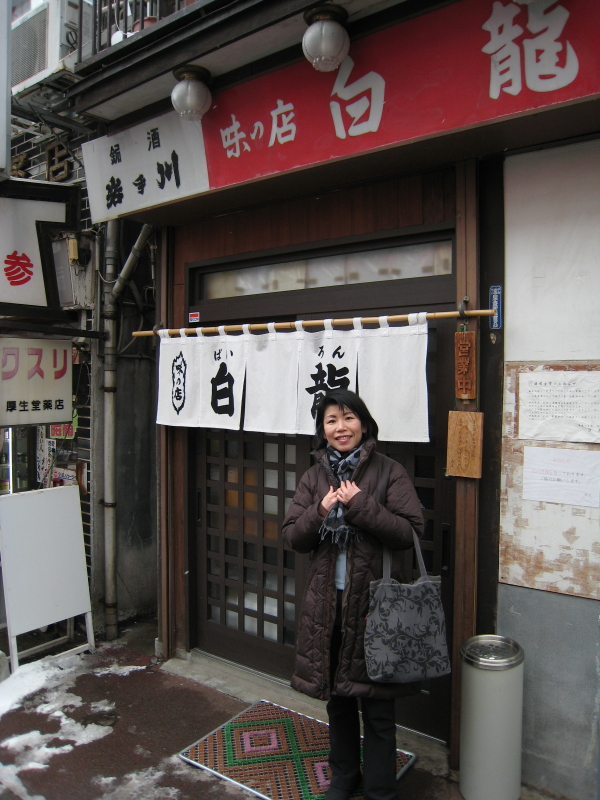
Now that we were in Morioka with time between trains, how could we miss the opportunity to sample one of great noodle dishes of Morioka?  With two hours til the next train, we bolted to the original Ja Ja Men shop, Pairon (白龍 ) near the Morioka Castle Ruins Park and City Hall.  It was during a lunch time when we arrived, and the shop was filled with salarymen working nearby.  It was a narrow,  hole-in-the-wall, with tables and counter sporting only the necessary chopsticks and condiments.  Salarymen were reading manga while they were waiting for their noodles.


We wasted no time ordering.  Delivered just as quickly, our bowls of Ja Ja Men were filled with white udon-like noodles topped with cucumbers and a mountain of ground pork and a special local miso on top, accompanied by grated ginger and pickles.  Noticing our cluelessness on how to eat it, the lady of the house came to the rescue and gave us a quick tutorial.  Reaching for the condiments, she added vinegar, grated garlic, and sesame oil, and quickly mixed the noodles with the miso, cucumbers, and ginger.

It was amazing!  Nothing seemingly special, yet so tasty, we still salivate when thinking about this unique dish.  The miso with ground pork was in perfect harmony with the udon-like noodle, vinegar and oil.  Many other salarymen came and went while we slowly savored each bite.

It wasn't over once we finished eating the noodles.  The lady then came to our table, picked up a raw egg on the table, cracked it open, added it to the dish, and brought the dish over to a man at the counter who was cooking the noodle.  He poured some hot water from noodle cooking pot into our bowls.  Our Ja Ja Men became an egg soup that blended perfectly with the mix of noodle, miso, and pork remaining in the bottom of the bowl. We finished drinking the soup and were left with nothing but a squeaky clean, a self cleaned dish!


Pairon
5-15 Uchimaru, Morioka, Iwate Prefecture
Japan
Phone:019-624-2247

Tuesday, April 12, 2011

Sendai City

We loved Sendai!  It is the capital of Miyagi prefecture and the largest capital in Tohoku region.  Sendai is very cosmopolitan, but not huge like Tokyo.  It is famous for gyutan (beef tongue) and lots of drinking establishments.  

We were shocked and saddened to hear that the city and surrounding area had suffered major damage from the earthquake on March 11, 2011.  What happened to Isshin?  What happened to Genji?  What happened to Aguraya?  We had wonderful sake and meals at these izakaya in Sendai, and we hope that the people we met there are safe.  

Isshin Kagenkan, specialized in Miyagi sake and atsukan (warm) sake.  A do-it-yourself sake warming device is found on each table.  


 Sendai's famous gyutan (grilled beef tongue) at Isshin Kagenkan.  Isshin was not  a gyutan speciality restaurant, but their thick-sliced gyutan was delicious. 
 
Cute and knowledgeable wait staff Tomomi-san at Isshin Kagenkan.

 
Genji, which opened in 1950 is a Showa era retro izakaya at Bunka-Yokocho.  After World War II, the area revived and thrived.

Okami-san at Genji.  Tsukedashi (small dish) comes with one drink order. There is a maximum of 4 drinks  (sometime more).  We first ordered a beer which came with a small plate of Tororo (mountain yam) with raw egg.  This first round cost 1000 yen.  The raw egg was so fresh and sweet that it tasted like vanilla custard when mixed with the tororo.  Second round was Aramasa Namazake paired with fresh homemade tofu.  Cost was1000 yen.  The tofu was so fresh and had great soy bean flavors. The beauty of this place was the drinks always come with food.

 Owner chef Sato-san at Ajitsukushi Aguraya, in Kokubucho-Dori.  The izakaya was recommended by Mr. Aoki of Kanetake Aoki sake shop which is just outside of Sendai city.  The Kokubucho-Dori is a famous entertainment street where you can find izakaya and bars to night clubs.  

 Food, sake, and shochu menu are posted at the ceiling of Aguraya.  They offer a wide range of sake and shochu.

 Drinking Onumaya Tokubetsu Junmai, local Miyagi sake.  Once pasteurized sake.

The entrance to Aguraya on the 3rd Floor of Abe Fort Building. 


Isshin Kagenkan
3-3-1  Kokubu-cho, Aoba-ku, Sendai, 980-0803
022-261-9889


Genji
2-4-8 Ichiban-cho, Aoba-ku, Sendai, 
022-222-8485


Ajizukushi Aguraya
Abe Fort Building 3F
2-1-10 Kokubu-cho, Aoba-ku, Sendai, 980-0803
022-262-8684


Sunday, August 10, 2008

Kuroson Browbeating Gives New Meaning to "Tataki"


When I was researching on Katsuo noTataki in Kochi, I frequently came across the name of Izakaya Kuroson. Bloggers aplenty had cited Kuroson as serving the best tataki in Kochi. After eating some wonderful Katsuo no Tataki at Yairo-tei in Hirome Ichiba the night before, I was dying to try the dish at Kuroson.

The afternoon after eating at Yairo-tei, I visited Hamakawa Brewery the maker of Bijofu and Shintaro sake, in Tano-cho, in southern Kochi by the Pacific Ocean. The president (shacho) of the brewery was youngish looking man in his 50's, who took over his family business several years ago. He was a down-to-earth and easy-to-hang-out-with. After showing me his brewery and leading me through a tasting of their sake, he asked me what I was going to do afterwards. I told him that I made reservation at Kuroson. His voice changed as he asked me, "by yourself at Kuroson?" He continued, "the food is fantastic, but...." His manner had me curious. "What do you mean by... 'but..."?, I asked. He hesitantly described the nature of owner. Apparently, he barks and yells at customers. He said that even he was a bit scared by him. My face was half-frozen. "Should I go there?," I asked. He said, "I am sure you will be fine, but I will go with you anyway."

Kuroson is located a narrow alley behind a Mos Burger (a Japanese fast food chain). They don't have a menu. You eat what you are served. Their sake list consists soley of Hamakawa Brewery's sake. The taisho (owner) is in his late 50's or early 60's, with short peppery hair and with high energy and spirit. His wife works as a waitress and they have been in business for 20 years or so.

First, we were served a huge plate of sashimi with five or six varieties of fish including, snapper, sea
bream, squid, and octopus. The sashimi was the freshest fish could possibly be, and the cut was very thick. It was neither gooey nor chewy, they had a springy yet soft texture, bursting with freshness. It was incredibly delicious and I enjoyed it but, the portion was beyond generous and I was beginning to get full before I'd even had the tataki for which I had come. I was eating slowly and chatting with Hamakawa-shacho when the taisho started to yelled at me. "Hayaku Tabenka! (eat quickly)!" I thought he was joking, but soon realized that it was no joke. He was dead serious.

Next came the tataki which was sliced very thick. With crispy skin and reddish pink meat inside, it was served with sliced garlic and wasabi. I bit into one of the huge pieces. It was heavenly! The fish was very fresh and texture was crispy outside and soft inside. The skin was so crunchy and flavorful that I could have been happy just eat the crispy skin for my snack. The skin was crispier and smokier than Yajiro-tei, and the slices were thicker and more tender. I felt the tataki was better at Kuroson.

As I was sipping my sake, savoring the tataki, and talking with Hamakawa-shacho we were accosted again by the owner, "Shaberazu tabero (don't talk, just eat)!" Trying to appease him, I looked up and begged him, "I am eating, I am trying."

I wanted to ask the taisho if I could take pictures of him and his restaurant, but I had become apprehensive about asking him anything. Sweating and waiting to be scolded by the taisho, I took a quick photo of the tataki.

It was then that I noticed that the couple next to me was also having trouble with the taisho. They had asked for a menu, a salad, and rice. It seemed that they were being a bit demanding and it was clear that the taisho and his wife were getting irritated. I spoke with the couple and learned that they were visiting Kochi from Hiroshima.

Suddenly, I heard the taisho yelling at me again, "Sassato tabenka (eat now)!" This time, it wasn't just him harassing me. His wife was also giving me a nasty look! My stomach had expanded to the point where I had no room for any more food.
My dilemma was that the tataki was so delicious that I wanted to clean my plate, but the fish was so rich that I couldn't finish eating it. No matter how many times I was yelled at, my stomach was stubbornly refusing to accept any more food. No amount of barking and yelling could make my stomach accept more. Eating was no longer a pleasure, it had become a demanding ordeal. Kuroson was no longer a restaurant. It had now become a battle zone.

Hamakawa-shacho felt so bad for me that he started to help me finish the dish. I needed to drink more sake to wash down the sashimi and tataki,
but the wife told me I couldn't order any more sake. Hamakawa-shacho and I were speechless. We felt so unwelcome that we decided to leave Kuroson immediately.

Hamakawa-shacho was very apologetic even though it wasn't his fault that we were thrown out. It was me who made them grumpy. No matter how nasty and abusive the owners had been, I still felt that it was the best katsuo no tataki I had ever had and was willing to overlook the browbeating that I had endured to eat it. I had never dreamed that the word "tataki" which can mean "to beat" would relate something about this experience other than what was served on my plate.

Afterwards, Hamakawa-shacho and I, joined by his wife and a co-worker, went to a nearby bar to drink more and to commiserate about the self-sacrifice that comes with eating the best katsuo no tataki in Kochi at Kuroson.

Kuroson
3-4-18 Honmachi
Kochi City,
Kochi 780-0870

Phone: (Japan) 088-873-2624

Saturday, August 09, 2008

Katsuo no Tataki in Kochi


Katsuo is Japanese for bonito, a species of mackerel. When Japanese people hear "katsuo," they immediately think of Kochi prefecture. Annual consumption of katsuo in Kochi is nearly four times that of other prefectures. Between 2005 ~ 2007, the national average was 1351g/ 3 lbs per two person household, but in Kochi it was 5183g/ 11.4 lbs!

Before my recent trip to Japan, I was longing to eat the REAL Katsuo no Tataki in Kochi
. The origin of Katsuo no Tataki is not well documented. Legend has it that Yamauchi Kazutoyo (or Katsutoyo) (b.1545- -d.1605), who became feudal ruler of Kochi in 1600, forbade eating fresh katsuo due to the possibility of food poisoning. To prevent illness, he ordered people to grill the katsuo before eating it. The origin of word "tataki" is also not well defined. The word "tataki" or "tataku" means "to beat," "to slap," or "to pad" in Japanese. Therefore tataki is known to be a cooking technique where a blade is used to pad the fish with salt to tighten the flesh giving it a desirable texture.

When I was daydreaming about Katsuo no Tataki while working at SAKAYA (our sake store), I had a customer from Kochi city. As soon as I learned that he was from Kochi, I asked him where to go to find the best Katsuo no Tataki. He recommended that I visit Yairo-tei at Hirome Ichiba.

Hirome Ichiba (market) is a kind of food court, but it is a place where there are about 65 shops including green market, fish markets, butcher, souvenir shops, sake retail shops, snack shops, takeout food shops, bars, and izakaya jammed into a huge building. It opened 10 years ago to promote local products and business. With its casual, down-to-earth atmosphere, you can order a dish from any of the vendors and then eat at the centrally located tables.

Yairo-tei is a small izakaya-style shop next to a takoyaki shop. When I arrived it was around 6pm, and people were already drinking and eating in front of Yairo-tei. I peaked inside and saw two salarymen sitting at the bar drinking. I decided to sit at the bar, so that I could have better view of the taisho (the owner chef) cooking the tataki. I then ordered a cold beer to keep from salivating too profusely while waiting for my tataki to be served.

I learned that in Kochi, Shio Tataki (salt tataki) is the norm. The more common or well known version of Tataki is the Tare version where the tataki is served with a special tataki sauce (soy sauce with vinegar and citrus). In Kochi, Shio Tataki is the more popular type, slightly grilled over a straw fueled fire.

At Yairo-tei, I ordered Shio Tataki. The taisho took out the katsuo and started to place the straw in the handmade grill box. Slowly the place became smoky and as my eyes started to burn, he placed the fish on the grill. He seared the fish quickly and placed it on a cutting board.

With quick and rhythmic strokes, he sliced the tataki, and served it on a plate with sliced daikon, garlic, sudachi (type of citrus), and wasabi. Without a moment's hesitation, I picked up a piece with my chopsticks and put it in my mouth. It was delicious! It was sublimely tasty; slightly smoky, meaty in texture and super fresh. I could imagine it as being popular alternative to tuna steak. Crispy on the outside and rare on inside, it was tender and toothsome with just enough fattiness to stand up to the garlic and wasabi condiments which added just the right amount of complimentary kick to the dish. I savored every piece, hoping to secure the experience in my sensory memory as how the best katsuo no tataki should taste.

Yairo-tei at Hirome Ichiba was just what the SAKAYA customer promised. It was casual, homey,inexpensive, and made great katsuo no tataki! When I left Yairo-tei, I vowed to come back someday with Rick to have the katsuo no tataki and try some of their other food. And, to drink more too!

Yairo-tei
Hirome Ichiba

2-3-1 Obiya-machi, Kochi
Kochi 780-0841
http://www.hirome.co.jp (Japanese only)


Thursday, March 22, 2007

Laos--Vientiane, March 3 & 4, 2006

Last year, we traveled to Southeast Asia. Since we have fallen a bit behind in posting our trip, and before it disappears completely from our "rearview mirror," we wanted to post some pictures and report on some of the highlights that we failed to get to when we returned last Spring .


Among our most memorable experiences was the capital city of Laos, Vientiane. Laos is a socialist republic in Southeast Asia bordered by China, Vietnam, Cambodia, Burma, and Thailand. In its more recent history, it gained independence from France in 1949, but civil war continued until the Communist party took over the country in 1975. Private and foreign enterprise started in 1987, but the country is still among the poorest in Asia.


Located along the banks of the Mekong River, the old colonial city of Vientiane is the capital of Laos. With dusty streets and crumbling sidewalks, it feels as if it has been in a sort of suspended animation since the early '70's. Yet, it has a distinctive charm about it because of its rusticity and lack of urbanity. It can easily be covered by foot (or better by bicycle) in a day.


One of our first stops was Pha That Luang, the Great Stupa, the national symbol of Laos. The construction of the stupa is known to be started in 1566 on the site of former Khmer temple. A Thai invasion followed by a Chinese invasion in 19th century severely destroyed the temple until France took the control of Laos in 1893. With the help of France, in 1930 the temple was rebuilt.

We rented bicycles for a day for 20,000 Kip, approximately $2 ($1=10,600kip) to visit temples and shops. Since the climate was very hot and humid, we kept our sightseeing activities to a minimum during the midday hours and took the opportunity to rest at a cafe, eat, and drink some of the delicious freshly squeezed local fruit juice.

We found a wonderful sandwich shop, Nampou Coffee near our hotel. During breakfast hours, local people were eating a noodle dish like Vietnamese Pho, which we decided to give a try. We also found that in Laos people eat Vietnamese Banh Mi like sandwich as well. The sandwich was filled with pork, cucumber, and sauteed onion and carrots with mayo and was perfectly matched with Beer Lao. We tried three different sandwich shop, and concluded that Namphou Coffee's sandwich was the best.

For dinner, one evening we feasted at a small family run place, Vilayluc, which we found via a Japanese guidebook. It looked like someone's home turned into a restaurant. The proprietor was very friendly, and we ordered her recommendation of laap (like laab in Thai), spicy curry and a dish she called "waterfall beef" (also similar to aThai dish). Since their history is so intertwined it is no surprise that Lao food resembles Thai, though like Vietnamese food, not as spicy. Lao dishes are filled with herbs and fresh vegetables, and you eat them with sticky rice. Khao Niaw, as it is called , is eaten with your fingers, molded into a ball and used to mop up the juice of the dish. We still remember the dinner at Vilayluc as one of the best that we had in all of Southeast Asia.


Namphu Coffee
57 Pangkham Rd., near the corner of Samsenthai Rd.

Vilayluc
behind Wat Ong Teu

Other Restaurants & Sandwich shops:

Soukvimane
turn left on Samsenthai Rd. on the road to That Dam

POV
344 Samsenthai Rod.


Thursday, February 08, 2007

Sushi at Araki

Since we rarely eat it at home, we wanted to indulge ourselves with a special sushi experience in Tokyo. We asked our friends living in Tokyo for their recommendation and without hesitation they replied, "Araki." Araki is not in Tsukiji or Ginza where there are a great number of sushi restaurants which open their doors to customers from all over the world. Rather, it is off the beaten track in the residential town of Kaminoge, about 20 mintues west of Shibuya station by train, where its devotees must travel to prove their desire to eat the very best . Our friends warned us that Araki would not be easy to get to via public transportation. But, from our dining experience, that's usually a good sign. The more remote, the more interesting the place tends to be.

After getting off the train from Shibuya, we left Kaminoge station at 5:45PM with map in hand. Our reservation was promptly at 6PM, so we had little margin for error. We walked for about 10 minutes, winding our way through a network of dark, quiet residential streets. At about 5:55PM, we arrived at the location where the restaurant was SUPPOSED to be. We looked around, but saw no sign of Araki. Hiroko asked a couple who appeared to be waiting for a bus, if they knew where Araki was, and they pointed to the door directly behind us!

At 6PM, the door opened. By that time, the 10 people who had congregated outside practically stampeded through the door and quickly claimed their seats at the counter. We took the two remaining seats at the end and we all sat and waited for our chef to emerge from behind a curtain....After our drink orders were taken, he took his place behind the simple wooden counter. A serious, stern-faced man in his late 30's, he was assisted by an equally stoic, extremely adept young woman in her 20's.

The atmosphere was somewhat solemn, and we felt a bit like we were in a karate dojo where the sensei demonstrates his moves and the pupils observe in silence. Noticing a few exchanges of familiarity between the other customers and chef, it became obvious that they were all regulars. We were the outsiders, and though the staff was cordial (and spoke English to Rick), it was clear that this was to a certain extent, a club. The master chef would allow himself a slight smile now and then, but he never laughed. When he spoke (infrequently) it was curt phrases uttered in a soft voice. He was a man of a few words who was completely focused on his craft.


After painstakingly careful preparation, each offering was individually presented. We started with a variety of sashimi including hamachi, abalone, uni and iIkura, and aji (horse mackerel). The hamachi was so fatty and tender that Hiroko couldn't contain herself and after putting it in her mouth, broke the reverential silence with an exclaimatory "oishii!" The uni was sweet like panna cotta or custard, and it was the perfect compliment to the slightly salty ikura that it was paired with.

Following the sashimi we were served a succession of sushi; three different grades of tuna (maguro, chutoro, and otoro), river fish, shirako (everyone's favorite, codsperm), shrimp, squid, and at last anago. Everything that we put into our mouths was sublimely delicious, perfectly prepared and proportioned. And the shari (sushi rice) was the best we've ever tasted!

Alas, at precisely 7:50PM our "shift" was over. And, as the 8PM reservation group arrived and we prepared to retrace our path back to the station, all we could do was agree that Araki was without question, the perfect sushi experience we had sought.


Araki
Kaminoge Little Town 102

4-27-1 Nakamachi Setagaya-ku Tokyo

03-3705-2256


あら輝

東京都世田谷区中町4-27-1 上野毛リトルタウン102
(03)3705-2256

Wednesday, February 07, 2007

Ramen in Ebisu


Unfortunately, we have yet to find a ramen place in NYC that meets Hiroko's standards. So, of course we were determined to eat ramen while we were in Tokyo. While exploring the Ebisu area, we headed for one of its most famous ramen-ya's, a place called Chorori. Spartan in its decor (or lack thereof), Chorori is extremely small with just a couple of communal tables. With its reputation, as you might expect, it was packed with hungry lunch patrons! We found two seats next to two young women who were clearly savoring their ramen. On our other side, a young man was waiting for his order, while across from him an older man was smoking his post-ramen cigarette. The atmosphere only exacerbated our anticipation of what lay ahead for our noodle-craving stomachs.

We ordered a shoyu and a shio ramen (which we were advised to be the standards) from the manager, a 40ish man was busily running around taking orders and clearing tables. Within 5 minutes, our ramen arrived, and before the noodles could soften (horrors!) , we joyfully dug our chopsticks into the bowl to capture and slurp the first few strands of noodle. The noodles were medium thin, a little curly and white, with a perfect chewy, al dente texture. The shoyu ramen soup delivered a deep, rich mouthfilling flavor. In contrast, the shio ramen soup was light, yet also flavorful and loaded with "umami." Toppings were simple; a slice of roast pork, crunchy fresh bean sprouts, and snowpeas. The belly-soothingly hot ramen made our noses run and caused us to break a light sweat as we happily slurped away until sadly, we caught sight of he bottom of the bowl.


Chorori
4-22-11 Ebisu Shibuya-ku
03-3444-7387


ちょろり
東京都渋谷区恵比寿4-22-11
(03)3444-7387

Yuba Udon Noodles


As we were walking around the Shirokane area of Tokyo, we found an old house just off a main street that had been turned into a restaurant named Sakura Sakura. The restaurant specializes in Kyoto-style dishes serving "yuba udon noodle" during lunch hours and kaiseki for dinner. It was just after 1pm on Sunday, and since both of us love and cannot get enough of yuba in any form, we immediately jumped at the opportunity.


We sat at a corner table with a space heater conveniently situated at our feet to keep our seat warm. The menu was a "build-your-own" style with a choice of noodles served either hot or cold, in soup or with dipping sauce. Plus, it also offered their special dish of noodles in sesame soup. There was also a long list of toppings to choose from, about 15 or so, ranging from scallion to tempura to slices of duck. Each order was accompanied by a bowl of mushroom rice and Japanese pickles.


Hiroko ordered the noodle in soup with scallions. Rick ordered the special noodles in sesame soup with scallion. Made from a mixture of yuba and flour, the noodles were thinner and not as springy as sanuki udon. They were delicate and soft and the soup broth was rich and aromatic...ub a word (Hiroko's) "beautiful." With hints of bonito and kelp flavors, the soup was light on salt and shoyu but delivered an abundance of dashi flavor. This "light flavored" soup is what Hiroko calls "Kansai style" (versus Tokyo or Kanto style which relies more heavily on shoyu).

Not to be overlooked, their rice was delicate and tasty as well. We devoured our lunch and then sat and savored it for a while longer over a nice cup of green tea. Through our visual sense, we had discovered a beautiful old house which yielded an equally beautiful sensory experience for our tastebuds, a bowl of yuba udon.


Sakura Sakura

5-15-10 Shirokanedai Minato-ku Tokyo

03-3440-7316


さくらさくら

東京都港区白金台5-15-10

(03)3340-7316


Tuesday, February 06, 2007

Soba for Breakfast?

When you were a child, did your parents always tell you that "breakfast is the most important meal of the day?" If you want to see what people on the go eat first thing in the morning, the best place to in Japan is the train station. In NYC, it will most likely be coffee and bagels or muffins. In Japan...well, let's just say that we would never have guessed that what we found would far and away be the most popular breakfast...

At about 6:30AM at Shinagawa station in Tokyo, we searched for a bakery to buy our breakfast. Bakeries are as ubiquitous in Japanese rail stations as hot dog vendors on NY street corners. But at this hour, no kissaten (coffee shops) or bakeries were found to be open at such an early hour. At first our sole choice seemed to be a convenience store selling onigiri, sandwiches, and juices. Not thrilled with the prospect, we decided to take one more look around. It was then that we spied a soba stand that was not only open for business, it was packed with early riser salarymen. Well, nothing beats a bowl of steaming hot soba noodles in cold morning! Sleepy eyed salarymen were busy slurping the soba, their concentration focused inside of their closely held bowl. We bought the coupons at the door, and waited at the table to be served. Service was quick, we wordlessly and happily slurped our order, and we were out the door on our way to our train in 5 minutes.

We had learned the salaryman's secret for starting the day...soba is the "breakfast of champions."

Tuesday, June 13, 2006

Experiencing Le Bernardin

Le Bernardin is universally regarded as the best restaurant in NYC. It has achieved the restaurant equivalent of a "grand slam" by receiving the highest review marks from Zagat, Michelin (3 stars), and the NYT's Chief Restaurant Critic, Frank Bruni (4 stars). How good is it? Does it really deserve all the accolades? Is the experience worth the price of admission? The restaurant offers a $105 prix fixe dinner consisting of three courses (two appetizers, one entree for you traditional diners) plus dessert. Since this falls a bit outside of our usual dining-out budget parameters, we decided to go there for a special occasion.

That occasion presented itself recently when we celebrated our first wedding anniversary. Upon arrival we were seated immediately for our 7:30PM reservation and were soon greeted by an amuse of roasted lobster in an asparagus bisque. As soon as Hiroko heard the "L word," she expressed her dislike for lobster to the waiter who without hesitation very kindly offered an additional amuse, an exquisite smoked wild salmon. Neither of us are usually inclined to order smoked salmon but this salmon had beautiful pale pink color and unlike most smoked salmon served in restaurants, it was not the least bit oily or salty and, its texture struck the perfect balance between firm and tender. As we savored each bite we imprinted it in our sensory memory as the gold standard for wild smoked salmon. Rick's first appetizer kanpachi tartare, a delicately composed interweaving of silky kanpachi with a whisper of citrus, olive oil, and fresh herbs, was also a classic example of how restraint and simplicity can produce maximum pleasure.

Along with its exceptional food, Le Bernardin is also a restaurant with a profound understanding of the importance of ensuring that their customers leave with the feeling that they've had the most enjoyable dining experience. They've mastered the art of focusing on pleasing their customer from every perspective. Our lobster amuse story exemplifies that ethic. Another instance occured when Hiroko diplomatically voiced her unhappiness with her first appetizer, a warm spicy octopus cut into small medallions, flecked with black olive and drizzled with aged sherry vinegar. After politely pointing out that it was too salty to enjoy the flavor of octopus and vinegar, to our surprise, they insisted on bringing another dish, an Escolar (Hawaiian white tuna) salad (which turned out to be Rick's favorite dish of the evening). We couldn't have been more impressed with their dedication to hospitality. Not only did they replace the initial dish, but it was accomplished with virtually no delay in our meal. There are not many restaurants that we've visited that deliver this level of exceptional multi-dimensional service!


One of our favorite dishes was a "progression" of fluke ceviches in four marinades: citrus, tomato and basil, ponzu, and lemongrass and coconut. It was very simple dish, but each of the four explored a different flavor and seasoning combination that made their own mark on the taste of the fluke. This perfectly light yet flavor-focused execution characterized the restaurant's deft ability to achieve balance among the elements of each dish on the menu.

Four-star restaurants don't always have great ambience. Le Bernardin has been said to have the look of an airport frequent flyer lounge or hotel lobby. We suppose the midtown location of the restaurant, its need to serve the corporate world, and the fact that it was designed in the mid-80's have something to do with its decidedly bland decor. Nevertheless, it certainly doesn't intrude on or distract the least bit from the dining experience... which may actually be a plus!

Overall, we had a wonderful evening. Service, as we noted earlier, was superb and even the dishes that we had that we don't mention here were of nearly equal caliber. Every course was well matched with by-the-glass and half bottle selections from the mostly French and American wine list (we were happy to see that several sakes were offered and in fact, we enjoyed one with the fluke). Le Bernardin is not an everyday kind of place (certainly not for us, at least!), but it is, indeed, the perfect place to go for a special occasion. Now that we've had the experience, we won't necessarily go again next month, but on another special occasion....we wouldn't hestitate one bit!

Monday, May 01, 2006

Youshoku

The final stop on our month-long visit to Japan was Matsuyama-city, where Hiroko's grandmother lives and where she went to high school. It was during this "natsukashii" (nostalgic) portion of our trip that Hiroko developed a yearning to eat Youshoku, which means "western cuisine" in Japanese. Although not prepared using traditional Japanese ingredients, Youshoku is loosely based on western ideas which have then been given a distinctly Japanese twist.

One of the most popular Yoshoku is Omuraisu, omelet rice. It is fried ketchup rice wrapped with an omelet. This peculiar dish is a favorite of many Japanese kids, and oddly, Hiroko still craves this strange dish time to time. Many Americans don't seem to embrace the flavor combination of ketchup, rice, and omelet. Although he grew up in a household where the ketchup bottle was always on the table for scrambled egg breakfasts, Rick is one of those who hasn't yet gained an appreciation for this dish. Since his youth, his tastebuds have somehow lost their affinity for ketchup, so he finds it difficult to understand why anyone would want to ruin good rice by mixing it with the wretched red condiment. But, in the name of love for Hiroko and her similar sentiment for this crazy concoction, he yielded to her desire to eat it while in Japan. So, off we went to the cafe where she had gone for her favorite Omuraisu when she was in high school.

When the the plate bearing the fluffy omelet delicately wrapped around the ketchup rice arrived at the table, Rick's curiousity got the best of him so he closed his eyes and tried one bite. As bizzare as this dish had seemed to him, after tasting it he admitted that it was not nearly as bad as he had imagined. His expression of newfound appreciation went virtually unnoticed as Hiroko's attention was focused on polishing off the Omuraisu before he could do further damage.

On this food journey down memory lane, the second Youshoku dish that Hiroko craved was lasagna. We went to a restaurant, which has the reputation for serving the best lasagna in the city. This lasagna, however, is not exactly Italian-style lasagna but rather the Japanese concept. Unlike the oven-baked dish of layered pasta, meat (or vegetable), cheese, and tomato sauce that most Americans recognize, this variety consisted of single layer of pasta, tomato sauce, cheese, and onions, presented to the table grilled in a cast-iron pan. The popularity of this dish has not waned a bit since Hiroko's high school days. When we went for lunch on a cold February day, the restaurant was packed with customers, most of whom were also eating this lasagna. What we didn't know as we surveyed this scene and inhaled the aroma of sizzling tomato sauce and melted cheese was whether they were reliving a memory or building one for the future.

Sunday, April 30, 2006

Perdue Never Knew....

When we visited Hiroko's father in Kagawa-ken, he took us to his favorite chicken joint, Ikkaku in Marugame-city. When he was a young salaryman in the 70's, he and his co-workers had made it their payday ritual to meet there to eat, drink, talk about the stresses of their job and unwind. Since it first opened in 1967 this izakaya has become so immensely popular for its signature dish, that it has spawned branches not only on its home turf, the island of Shikoku, but also across the country in Yokohama City (near Tokyo) and soon in Osaka as well.

Now, about that signature dish.....Hiroko's father awkwardly warned us in advance that Ikkaku's chicken is "nothing like that ordinary tender grilled chicken. This chicken is much chewier and so much better." We didn't quite know what to expect, but told him we were game to try it...after all if it was little chewy but more flavorful, why not? Well...

Ikkaku's menu is short, simple, and straightforward consisting of "Oyadori" (adult chicken), "Hinadori" (young chicken), and a few other small dishes like edamame, salad, chicken rice, and soup. Needless to say, this simple kind of food was meant to be eaten with continuously flowing beer, sake, and/or shochu.

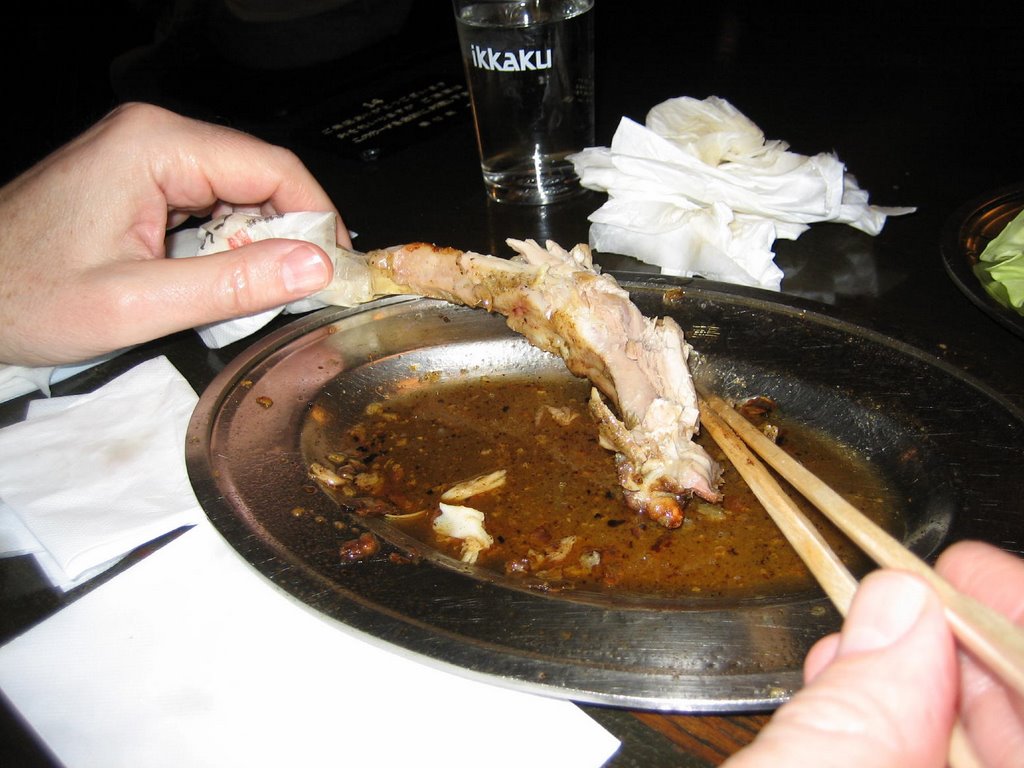
At Hiroko's father's insistence, we started with a beer and the Oyadori (adult chicken). A plate bearing a chicken leg and thigh arrived in front of each of us. The chicken was redolent of garlic, oil, and a blend of black and red pepper. It looked and smelled delicious. The scent of the glistening spicy grilled meat made us salivate immediately. Rick bit into the chicken. The meat didn't budge from the bone.. It became apparent that Hiroko's father's warning was no understatement. This Oyadori was not the least bit tender at all; and was just the kind of "tough chicken" that would make a tender man of Frank Perdue (or at least be his nightmare). But, the flavor of the chicken was so irresistably tasty and toothsome that it was next to impossible to stop attacking and chewing the meat....maybe it brought out the deeply buried primeval satisfaction of the early carnivores. Our fingers were covered with juice and our lips were happily buzzing with spices from the marinade. We had to keep licking our fingers, it was senseless to continue to try to use napkins.

Hiroko's father believes that once people have the Ikkaku experience, it is difficult to go back to eating tender chicken...it is almost as if tender chicken does not have the flavor or provide the satisfaction that should come from eating this farmyard (or probably freerange in this case) fowl. And, as we cleaned the last bits of meat from the bones, we could clearly understand why he felt that way. After the Oyadori, we ordered some "Hinadori" (young chicken) for comparison...yes, it was juicy and tasty, but somehow now it just seemed ordinary.

Monday, April 10, 2006

Udon


With our apologies to the Declaration of Independence, all Udon are not created equal. There are all other udon noodles and then there is Sanuki Udon. Sanuki Udon is the ultimate udon noodle, according to Hiroko, who was born and raised in Kagawa-ken, the birthplace and ancestral home of udon (think bagels and New York).

Sanuki Udon is different from the udon noodles from other places in Japan. It is shinier and silkier in color and more springy in texture. While we were driving around town, udon noodle shops (small restaurants) were as ubiquitous as nail salons in Manhattan. Most of these shops are quite small and many of them are self-service.

The way to order sanuki udon is:

1. Order the type of udon noodle dish (i.e. the preparation)...Zaru Udon or Kake Udon, etc.
2. Specify size/quantity i.e. small, medium, and large.
3. Wait patiently (for usually a minute or two) and recieve the bowl of noodles.
4. Choose from a selection of toppings e.g. vegetable or shrimp tempura or fishcake for the noodle (if desired).
5. Pay the cashier (a little over a dollar).
6. Find a seat
7. Eat!

On our visit to his ryokan in Kotahira (a town at the foot of the mountains in Kagawa-ken prefecture), Hiroko's friend's brother drove us to "Yamagoe, "the most popular udon shop in Kagawa. Located about 40 minutes from the town, it was easily identifiable as it was surrounded by nothing but a rice field and parking lot. Despite what sounds like an obvious location, what really made the place easy to spot was the line of people standing outside the entrance waiting to order their noodles! Yet even after arriving during a snow squall and taking our place in line on this blustery cold winter day, we had placed our order and were seated at a counter happily slurping our sanuki udon in less than 5 minutes! After having our faces buried in our bowls for the ensuing 5 minutes, we exchanged grins, our tastebuds were smiling and our bellies full!

Saturday, April 08, 2006

Sake and Nabe in Osaka


While in Osaka, we visited Daimon Sake Brewery for a tour followed by a tasting and then lunch. Daimon Brewery is actually located east of the city, about 45 minutes by train from Osaka Station. Founded in 1826, the kura (brewery) is situated in a small village bounded by a mountain range to the east from which it draws an abundance of clean water. Long ago, during Edo period this region between Osaka and Nara (the ancient capital prior to Kyoto) was populated with as many as 1,600 sake breweries. Currently, only a few remain.

Yasutaka Daimon, the director and 6th generation of the Daimon brewing family, began with a brief introduction to the process of sake-making and then led a tour of the brewery. After learning about how the product was made, we tasted six different varieties that Daimon makes ranging from their fresh namazakes (unpasteurized) to their Junmai, Junmai Ginjo, and Junmai Daiginjo nihonshu (sake).

After the tour and tasting, it was time for lunch. We were led to their small restaurant upstairs from the brewery and seated at a small shin high table. The lunch served was Sakekasu Nabe with Salmon paired with our choice of sake.

For those of you who may be wondering what Sakekasu Nabe is, here is the explanation.

Sakekasu comes from the process of making sake; when rice, koji (mold produced when rice is affected with yeast), and water is fermented, the liquid part becomes sake and the solid residue from that process is sakekasu. Nabe is a "hot pot" dish (think fondue with a broth cooking medium) that is very popular during the winter in Japan. Nabe simply means "pot," which is usually made from clay. The nabe (pot) is usually prepared over a gas burner on the dining table. Beginning with dashi (bonito flake based) stock, various ingredients like vegetables, mushrooms, meat or seafood are added to it once it comes to a boil. There are many regional varieties to this dish, and there are really no rules about what to put or not put into the nabe. It is a very social dish, and it is common for family and/or friends to gather around the nabe and drop fresh ingredients in the hot pot while they eat, drink, and talk at a leisurely pace. We observed four men enjoying their sake and nabe experience so much that their glacial eating pace necessitated some gentle nudging along by the servers when all other diners had finished. This is the way it is meant to be!

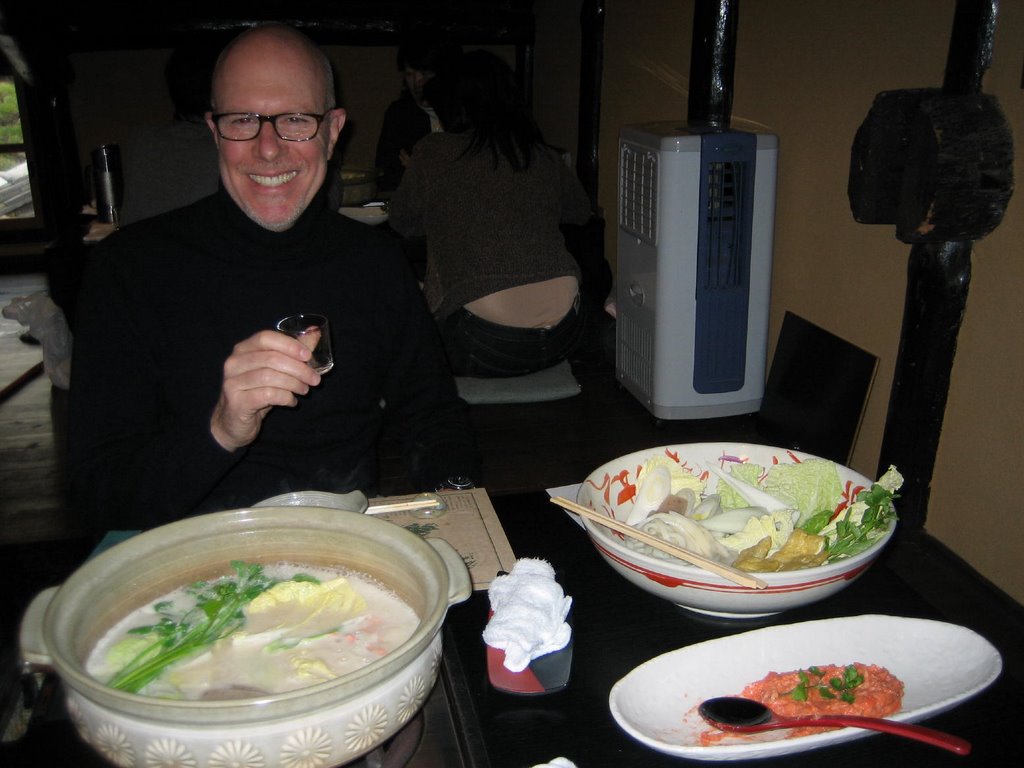
The server brought us a big clay pot filled with dashi mixed with Sakekasu and placed in on the stove in the center of our table. While the Sakekasu dashi bubbled, we dropped the fresh vegetables and salmon into the hot pot to cook our meal. Sakekasu has the fragrance of sake... it was mild and not as sharp as miso flavor. The rich salmon was great compliment to the mild sake flavor. To go with this we ordered a nama (just-made fresh sake) to go with our lunch. It was the perfect meal for a cold winter day!

We left Daimon with our very own bag of sakekasu, compliments of the brewery. And although we had many more travels ahead of us, we were already thinking about making Sakekasu Nabe in Brooklyn.


More photos of eating in Osaka? Click here!