Wednesday, January 31, 2007

Ainokura -- World Heritage Site


Ainokura is in the Gokanyama district where villages of centuries old-style houses are scattered along the main route through the mountainous region of Toyama prefecture in north central Japan. Here in the village of Ainokura, nature is preserved and time is as frozen as the ground beneath the two-foot deep snow in winter. We found the village to be extremely authentic and well preserved owing to its status as a World Heritage Site declared by UNESCO in 1995. The style of houses found here called Gassho-zukuri, comprises an "A" shaped thatched roof made from straw. Currently there are 21 Gassho-zukuri houses nestled in Ainokura village.

Getting to Ainokura was quite a challenge. It required two trains and two buses from Tokyo to Nagoya, Nagoya to Takayama, Takayama to Shirakawa-go (another World Heritage Site), and finally from there to the remote village of Ainokura. Since it is an especially small village, Ainokura has very limited bus service. If we were to miss one connection in the chain, we would miss the only bus available to get us there. Knowing the precision needed in making our connections on time, we left Tokyo at 7am by the Nozomi Shinkansen (fastest bullet train in Japan) and transferred to the train from Nagoya to head north to Takayama, the largest city in the middle of Gifu prefecture. The Nagoya train to Takayama was delayed by 30 minutes, which nearly gave Hiroko a heart attack. Fortunately, the first bus that we needed to get us to Shirakawa-go waited for our late train (unbelievable for Japan). Fortunately for us, we were then able to successfuly make the transfer to the bus from Shirakawa-go to Ainokura. It was almost 2:30pm when we stepped into the gassho-zukuri house in which we were to stay the night.


We stayed in one of the oldest houses, Yusuke, which was built 1868. Now inhabited by the 5th generation of the same family. Shigeru Ikehata, a well-traveled professional photographer, runs the inn with his wife. As we were the only guests for that night, Ikehata-san regaled us with his fascinating stories, making our experience more of a homestay than that of just typical ryokan customers.

It was about 32 degrees outside, with 2-3 feet of snow covering the ground, so the house was cold. In Japanese houses past and present, there is no central heating system and in this rustic case, the only heat source was from Irori (fire in a central hearth). After our explorations outside, all we wanted to do was sit by the fire, drink hot tea, and bask in our before-dinner ofuro (Japanese hot tub, to simplify things tremendously).


That evening, dinner was served in front of the Irori. We were treated with dishes filled with different combinations of mountain vegetables, koi sashimi, and a river fish called Iwana. When futon-time came, we were handed bed warmers and retreated the refrigerator-cold room with freezing cold futon. We quickly got into the bed and hoping that the bedwarmers would do their job...which they did!

When morning came, the room was even colder. Hiroko (somewhat) jokingly said that her hair was covered with frost. We tucked our clothes under the covers of the warm futon to warm them up before putting them on our bodies. And, we quickly dressed and headed for the irori. After a breakfast of warm tofu, miso soup, rice, tsukemono, it was time for us to leave. We thanked our gracious hosts for their generosity and headed off into the early morning mountain mist for the bus stop to catch the bus to Shirakawa-go.


Our Sake Journey


Almost exactly one year later, we returned to Japan. This time, our primary reason was to take John Gauntner's Professional Sake Course, an intensive 3-day affair of lectures, tasting, and eating dinners accompanied by a number of different sake.

Sake is very much a reflection of Japanese culture, where "aimai" or ambiguity is deeply woven into lives and personalities. Vagary rules. When it comes to gastronomy, anything goes as long as it sounds and tastes good. That's what we deal with in the world of Sake when it comes to both tasting and understanding the industry.
Junmai-shu (sake) has its own specific general aromatics and flavor profile characteristics, but there are always exceptions to the definition, which we all seek to make it easier for us to grasp and understand. To understand Sake is to understand Japanese culture. John taught us not only the technical side of sake brewing, classification, and tasting, but also the cultural aspect of sake drinking in Japan.

Tasting sake requires an immense amount of focus and concentration. There are aromatics, flavor profile, and texture to consider. With acidity, sweetness, bitterness, umami, aimami, and koku to ferret out with each experience, we had to focus on our tongues and mouths to isolate each quality and identify the flavor. Light and "feminine" or sturdy and "masculine?" Intensely fragrant or delicate? Viscous or etherial? Notes of mushroom, rose petal, banana, strawberry, apple, or pear? Simple, dry, or complex? As with wine, there is no end to the subtleties, nuances and the the adjectives to describe each uniquely created sake!


We tasted by yeast type, rice type, brewery, by classification (i.e. yamahai, honjozo, junmai, ginjo, daiginjo, etc.), age, serving temperature, and geographic region of origin. What we found fascinating was how variation in serving temperature can produce a transformation in aroma and flavor. A perfect illustration of this was a particular kura's Yamahai (a sake made by an ancient labor intensive method), which seemed to be everyone's favorite. Chilled, this sake was very strong with a nose of dried mushrooms. (Hiroko who hates dried shiitake mushrooms could not truely enjoy it). Remarkably, after warming, its flavor was transformed from the shiitake mushroom to that of a less intense (and for Hiroko, preferable) enoki mushroom. Although we'd read about the enjoyment of heating premium sake to various temperatures, this was our first actual tasting experience and it was definitely an eye opener!

Sake styles and types are as diverse as Japan's 47 prefectures, multiplied by the approximately 1,400 brewers, and compounded by the specific water of the brewery locale, yeast and rice types used, and proprietary brewing methods, just to name a few of the factors...you get the idea. If you're interested in learning more please either write us or check John's website for the most comprehensive resource on sake!


Sake World by John Gauntner

Wednesday, November 29, 2006

"No Knead Bread" from NYT


Baking your own bread is difficult and time consuming, right? No longer! Mark Bittman shared his simple bread recipe in 11/8/06 issue of NYT. Hiroko was thrilled to try it and yes indeed, it is very easy...

After mixing the bread flour with salt, yeast, and water, let the dough rest for 18 hours. Then, wrap the dough in a corn meal-covered towel, and allow it to rest for another 2 hours or so. Heat a cast- iron pot with lid in the oven at 500 F for 30 mintues. Then, place the dough in the pot, close the lid, and bake for about 30 mintues. Closing the lid will create a steaming effect in the pot. After 30 minutes, remove the lid and bake for another 15 to 20 minutes until the bread becomes a golden color and voila!

Bread was very moist with a chewy texture. Even our Italian friend Maria said that the bread is very similar to breads she used to eat at home in Modena. That's a huge compliment for an inexperienced bread maker! Thanks to Mark Bittman, anyone who is willing to try his recipe can now savor the joy of freshly baked homemade bread!

Salt Baked Fish

One afternoon Hiroko exclaimed, "I want to cook a whole fish!" Being an omnivore who leans toward meat, Rick gave her a quick sideways glance, but he could see that she was determined to buy and cook a whole fish. For quite some time she had longed to try a recipe that she had found for Salt Baked Fish. For years we've heard that baking fish in salt is the one of most delicious and simple ways to enjoy fish. Rick surrendered to her wish and went shopping.

Since red snapper wasn't available that day, we chose pompano for the dish. After preparing a mixture of salt with egg whites, we placed the fish on the bed of the salt mixture and covered the fish with the rest, and then, baked the fish in 400 degree F oven for about 30 mintues.


When we cracked open the salt casing after 30 mintues, the fish meat was flavorful, moist, and tender. And as Hiroko had promised, it was a delicious way to eat a fresh fish.

Tuesday, September 26, 2006

Vacation in California (Yosemite)

We just returned a hiking/food fest in California. After spending a few days hiking the breathtakingly vertical trails in Yosemite, we headed west for four days of diverse, delicious food in SF. Unfortunately, we lost our camera on our arrival in SF, so we have no pictures of our vacation! Too bad too since there was some spectacular scenery in Yosemite and equally gorgeous weather in San Francisco. Nevertheless, we have some great visual and sensory memories imprinted in our minds to carry with us (although it would be more interesting for you).

Our Yosemite visit was nothing less than fantastic! We had two full days in the park; on the first, we hiked short trails to Lower Yosemite Falls (a trickle at this time of year) and through the Mariposa Grove (of giant sequoias) and drove up to Glacier Point where we were to begin a more rigorous hike the next day. From that point overlooking the entire Yosemite Valley, the familiar glacial rocks, El Capitan and Half Dome, as well as the Nevada and Illiouette Falls, on day two, we hiked the 8.7 mile Panorama Trail. Half Dome is its signiture landmark, and it was majestic and beautiful. Shaped like a slice of watermelon, it is smooth and rounded on one side and sheer vertical cliff on the other. All along the winding Panorama Trail, we kept seeing the Half Dome at different levels (altitudes) and from new angles as we decended from 7200 ft. to 4000 ft. The final two mile segment of the Panorama, called the Mist Trail, runs along the waterfalls, and was by no means easy going. Following the near vertical drop of the falls is an unending trail of rock "steps" (and that is a VERY loose use of the term). In reality they weren't much more than what looked like a jumble of rocks and more rocks left by the last glacier of 3 million years ago. Given the strenuous demands and mental exhaustion (from having to focus on not twisting and ankle or falling) that we experienced we found it difficult to conceive of climbing the trail that we had descended. Hiroko became dizzy looking down and walking down the steps and the front thigh and shin muscles in my legs ached for the ensuing two days as if I had just made my first visit to the gym. In the end, it took us about 6 hours to finish the trail, we began the trail around 10:00 am and finished around 4 pm. Needless to say, we slept VERY well that night!

Sandwiches in San Francisco

We walked around San Francisco looking for great eats. After reading blogs and reviews, we realized that we had to try the subs at Marina Sub.

Marina Sub, a non-descript sandwich shop owned by the same Asian man who makes an array of overstuffed submarine sandwiches (hero, grinder, hoagie...call it what you will) is located at the corner of Union and Steiner Streets in the Marina section of San Francisco. When we arrived at about 1PM, there were only a few customers waiting on line with a handful seated at one of the sparse tables, eating their sandwiches. What we discovered was...the man sure knows how to make sandwich! Of particular note, is the impressive way in which he peels and slices an avocado. The man was a finely tuned machine; taking orders, making and toasting sandwiches, and then wrapping them with no wasted effort. It was the fusion of art and efficiency!

There are 3 sizes to choose from: small (5 inches), medium (7 inches), and large (10 inches). After having some time to observe while waiting, we opted for sharing a large "Italian" on which he first put mustard on one side the large Italian style baguette (we almost stopped him but are glad that we didn't), to which he then added cappicola, salami, mortadella, and provolone. He then put them in the oven to toast. While he was building our sandwich, he also prepared several phone ordered sandwiches and took orders from the next customers in line. When the sandwich was toasted, he added mayonnaise, shredded lettuce, tomato, and Italian dressing, then using his long knife closed the bread tightly and neatly wrapped it.

The sandwich was as tasty as we had anticipated from observing its construction. The bread was soft and lightly toasted, and the contents blended perfectly with the flavors of the mustard, mayonnaise and Italian dressing. It was well worth the walk there and we enjoyed the rare good fortune of a relatively short wait. Because, by the time we left, the line was out the door and around the corner!

Friday, September 22, 2006

Banh Mi in San Francisco

Our passion for banh mi is no secret. As our blog profile proclaims we look for this delicious Vietnamese sandwich everywhere we go. Aside from our favorite local shops in NYC (Saigon Banh Mi, and Hanco's), our global search has led us to sample them in Seattle and Portland as well as in Hanoi and Vientianne (Laos). Most recently on a trip to Yosemite and San Francisco, we had the opportunity to add a new favorite to our list. Hiroko's usual exhaustive research led us to the consensus choice for best banh mi among San Francisco's eating enthusiasts...Saigon Sandwich. So, of course, we had to try it.

The shop, located on Larkin street in Mission, is small and simple. When we got there, no line was formed and only one man was eating his banh mi at a, make that THE small counter, in the front window. The proprietor, sweeping the floor, without missing a broomstroke, took our order for the special banh mi, i.e. doc viet.

Without a doubt this is the best we have eaten so far. Yes, even better than the hallowed Saigon Banh Mi on Mott Street, we thought. With a generous amount of the tasty mix of pate, grilled seasoned pork, pickled carrot and daikon, cilantro, and price was $2.75! While we were savoring the sandwich, the line grew longer and longer. We seemed to got there just in time!

Sunday, September 10, 2006

Chocolate cake


A cake is not Hiroko's favorite dessert to make. She is scared to make sponge cake because she doesn't own an electric mixer (which is a most useful gadget to have when whipping and mixing butter, egg, and sugar). That's her excuse not to attempt baking cakes. However, she realized that if she never tries, then she will never improve her skill, either.

After avoiding her loan baking fear for many years, she was moved to face it when Rick requested a chocolate cake for his birthday. At first, she didn't really want to make it, but then she decided it was time to take on the challenge.

Instead of the plain and typical chocolate sponge cake, which required her to whip egg and whites, Hiroko discovered a recipe for the cake using buttermilk, which didn't require whipping the eggs.

This recipe from December 2005 issue of Food & Wine uses coffee and butter milk to create a moist, rich and fudgy cake. She used Scharffenberger's bittersweet chocolate for her frosting and it was very dense and VERY chocolatey. As you can see in the photograph above, it wasn't the most professional looking, but it was delicious and it completely satisfied our chocolate craving. It was Hiroko's first try and she was happy with the results for a first effort. And now that she has overcome her fear of baking chocolate cakes, her only remaining fear is maintaining her waistline...

Duck


As Rick's birthday approached, Hiroko wanted to create something she had never prepared before. She went through cookbook after cookbook and found a relatively simple recipe for DUCK. It can be prepared in advance, which is allowed more time for the preparation of the other dinner dishes and dessert.

The aforementioned recipe is for Chilled Duck with Zinfandel Sauce from Food & Wine's 2004 Cookbook. After browning the duck breast in a cast iron pan, she placed it in a ziploc bag containing a Zinfandel, mirin, and soy sauce mixture. The following day, she cooked it in what trendy chefs are currently calling the "sous vide" method by placing the bag in a pot of boiling water for 10 minutes. Once cooked, the bag with the duck and marinade is plunged into a bowl of ice water and chilled for 45 mintues, and then popped it in the refrigerator to marnate overnight.

Just before the dinner, Hiroko warmed up the duck and sauce, and served it by placing the sliced duck breast on each plate and drizzling it with the warmed zinfandel sauce.

It was most and delicious...in a word, fantastic! Somehow, the picture we took does do it justice. You will just have to trust us and try it yourself with a few glasses of Martinelli Jackass Vineyard Zinfandel to simulate Rick's best birthday meal in memory!


Saturday, August 12, 2006

Corpse Flower

This is the infamous Corpse Flower, which is known to produce a stinky odor similar to that of decaying flesh (now you know where the "corpse" appellation comes from). First discovered in 1878 by a scientist Odoardo Beccari in Sumatra, and formally know as Amorphophallus titanum, it was thought by the local people to be carnivorous because of the powerfully pungent smell. In fact, the odor exuded by the plant was intended to attract carrion beetles and small bees that would spread its pollen. The Corpse flower last bloomed in NY in 1939. It's anticipated blooming has received extensive coverage in the New York press this week.

This particular flower, housed at the Brooklyn Botanic Garden, bloomed on Friday, August 11. When we saw it on Saturday at around 11am, the noxious smell had (mercifully) dissipated. Although we arrived a little too late to experience the infamous odor, we were able to see the unusual looking flower, which blooms so infrequently and for such short duration (and has provoked so much controversy over time....women weren't allowed to view it in the Victorian era).

Tuesday, July 18, 2006

Berries

Berries are in season now! In either supermarket or farmer's market, we are greeted by sweet aroma of berries. We've seen a one pound package of strawberries for $2.99 or 2 pound package of blueberries for $3.99.

Rick eats blueberries on his daily bowl of cereal in the morning but, never are they as tasty as they are right now. But with three pounds of irresistably fat, ripe, deep colored berries to eat, what to do with them before they spoil...what a travesty that would be! Solution? Make berry tarts!

Hiroko has been working on perfecting her tartmaking skills for a year. And the more tarts she makes, the better they get! Lately she has finally confessed (modestly) that she is finally comfortable with her tart shell.

She makes a sweet pastry shell from flour, butter, eggs, sugar, and ice water. And, for the filling....... lots and lots of berries! If you'd like to know her recipe, let us know. How can you resist one that has been a year in the making? Especially during berry season.

JR Pottery


Since we returned from Japan, we've become fascinated by and interested in Japanese style pottery. We tend to go for unusually shaped and handmade "one of the kind" designs. Recently, Rick's Uncle Carl generously sent us beautiful Bizen-yaki plates made by American man named John Ray. He studied and honed his pottery skills in Okayama, which is reknowned for Bizen-yaki.

We love the organic, earthy shape, texture, and feeling of the plate. We were told that it is a sushi plate, but why just limit its use to sushi when its design makes any food presented look and taste delicious. We've use them for serving appetizers or salads (no sushi as yet).

Check out John Ray's website to enjoy some of his beautiful work!


Thursday, June 29, 2006

Ugly Dumplings

Our favorite quick and cheap lunch place is Fried Dumpling in Lower Manhattan. It is a small storefront and Chinese ladies handmake the dumplings on site. It is one of the best bargains in New York, $1 for 5 dumplings! You can eat them in the shop at a tiny counter with soy/vinegar and/or hot sauce supplied in recycled squeeze bottles or get them to go. A bag of 30 frozen dumplings, is a whopping $5!

After observing the ladies making the dumplings, Hiroko decided to make her own from scratch. She consulted dumpling/gyoza recipes from websites to cookbooks, and picked the gyoza recipe from one of her Japanese cookbooks.

She started by making the dough, mixing the dry ingredients with warm water. After pounding and kneading for 10 minutes, the dough reached the proper texture approximating that of an earlobe....this guideline courtesy of the cookbook. Now it was time to allow the dough to rest in the refrigerator for an hour. While the dough napped, she prepared the stuffing using ground chicken and pork and mixing the meat with minced ginger, scallions, and garlic.

So far, it seemed very simple and easy. The struggle began when she tried to roll out the dough into small individual wrappers. She rolled the dough into a log about 1-inch in diameter and then cut it into 1-inch slices. She then carefully rolled each out into a thin crepe-like sheet. The recipe made it look as if these would be easily rolled out into a round shape. However, everytime she rolled out the dough, it was neither round nor square. After awhile, her rolling skill improved a little, but the wrappers were still far from being a nice round shape.

She filled the wrappers with the seasoned meat stuffing, but they resembled ugly croissants more than dumplings. Rick suggested to cut the dough using a round cookie cutter, so that the wrappers will have uniform shape.

Hiroko fried the dumplings in grapeseed oil while Rick made the simple soy/vinegar dipping sauce. After tasting it, we realized that Hiroko had forgotten to add salt to the stuffing mix. Although the use of some salt is recommended we found that once they made contact with the dipping sauce and entered our mouths, our first homemade ugly dumplings tasted beautifully juicy and delicious!

Hiroko gained a new appreciation for the skill of the dumpling ladies at Fried Dumpling. Each return visit presents her with another opportunity to observe their technique and marvel at how they roll out the nice round wrappers.

Sugar Snap Peas


Sugar snap pea season is here! We look forward to this time of the year to buying sugar snap peas at Greenmarket. On a recent Saturday we made a special trip to the market in Union Square to see if the local producers were offering them yet. And sure enough, we spotted the peas filled a bag with several handfulls, and we have been eating them practically everyday since.

The way we like to eat them is simple. Cook them for 1 minute in boiling water, drain and run under cold water to chill and arrest the cooking process. The sugar snap peas are very soft and can be eaten raw, so it isn't necessary to cook them more than 60 seconds. This blanching in the boiling water is just enough to bring out the beautiful bright green color.

Eat them plain or dip them in a sauce of your own choosing. We like a slightly spicy mix of Kewpie mayonnaise and yuzu kosho paste (or Kewpie and miso). Enjoy them now (preferably with a glass of rose) because the season is short and there's nothing like the local variety!

Tuesday, June 13, 2006

Experiencing Le Bernardin

Le Bernardin is universally regarded as the best restaurant in NYC. It has achieved the restaurant equivalent of a "grand slam" by receiving the highest review marks from Zagat, Michelin (3 stars), and the NYT's Chief Restaurant Critic, Frank Bruni (4 stars). How good is it? Does it really deserve all the accolades? Is the experience worth the price of admission? The restaurant offers a $105 prix fixe dinner consisting of three courses (two appetizers, one entree for you traditional diners) plus dessert. Since this falls a bit outside of our usual dining-out budget parameters, we decided to go there for a special occasion.

That occasion presented itself recently when we celebrated our first wedding anniversary. Upon arrival we were seated immediately for our 7:30PM reservation and were soon greeted by an amuse of roasted lobster in an asparagus bisque. As soon as Hiroko heard the "L word," she expressed her dislike for lobster to the waiter who without hesitation very kindly offered an additional amuse, an exquisite smoked wild salmon. Neither of us are usually inclined to order smoked salmon but this salmon had beautiful pale pink color and unlike most smoked salmon served in restaurants, it was not the least bit oily or salty and, its texture struck the perfect balance between firm and tender. As we savored each bite we imprinted it in our sensory memory as the gold standard for wild smoked salmon. Rick's first appetizer kanpachi tartare, a delicately composed interweaving of silky kanpachi with a whisper of citrus, olive oil, and fresh herbs, was also a classic example of how restraint and simplicity can produce maximum pleasure.

Along with its exceptional food, Le Bernardin is also a restaurant with a profound understanding of the importance of ensuring that their customers leave with the feeling that they've had the most enjoyable dining experience. They've mastered the art of focusing on pleasing their customer from every perspective. Our lobster amuse story exemplifies that ethic. Another instance occured when Hiroko diplomatically voiced her unhappiness with her first appetizer, a warm spicy octopus cut into small medallions, flecked with black olive and drizzled with aged sherry vinegar. After politely pointing out that it was too salty to enjoy the flavor of octopus and vinegar, to our surprise, they insisted on bringing another dish, an Escolar (Hawaiian white tuna) salad (which turned out to be Rick's favorite dish of the evening). We couldn't have been more impressed with their dedication to hospitality. Not only did they replace the initial dish, but it was accomplished with virtually no delay in our meal. There are not many restaurants that we've visited that deliver this level of exceptional multi-dimensional service!


One of our favorite dishes was a "progression" of fluke ceviches in four marinades: citrus, tomato and basil, ponzu, and lemongrass and coconut. It was very simple dish, but each of the four explored a different flavor and seasoning combination that made their own mark on the taste of the fluke. This perfectly light yet flavor-focused execution characterized the restaurant's deft ability to achieve balance among the elements of each dish on the menu.

Four-star restaurants don't always have great ambience. Le Bernardin has been said to have the look of an airport frequent flyer lounge or hotel lobby. We suppose the midtown location of the restaurant, its need to serve the corporate world, and the fact that it was designed in the mid-80's have something to do with its decidedly bland decor. Nevertheless, it certainly doesn't intrude on or distract the least bit from the dining experience... which may actually be a plus!

Overall, we had a wonderful evening. Service, as we noted earlier, was superb and even the dishes that we had that we don't mention here were of nearly equal caliber. Every course was well matched with by-the-glass and half bottle selections from the mostly French and American wine list (we were happy to see that several sakes were offered and in fact, we enjoyed one with the fluke). Le Bernardin is not an everyday kind of place (certainly not for us, at least!), but it is, indeed, the perfect place to go for a special occasion. Now that we've had the experience, we won't necessarily go again next month, but on another special occasion....we wouldn't hestitate one bit!

Thursday, May 25, 2006

Try a Little Tenderness....Braised Beef Cheeks


To put it in the terms used by our friend Harris, the weather has been a little "schizo" this Spring. When the forecast predicts rain, we are treated to (the always welcome) blue sky. When fair skies are expected, we are subjected to a deluge. One day last week, the evening news weather forecast promised that it would rain the entire following day. Rather than just sit at home and watch the "rain in vain," we decided to make the most of the drearily inclement weather and prepare a recipe that we had recently read for slow cooked beef cheeks. This particular recipe requires the cheeks to cook at a low oven temperature for 8 to 10 hours. What better way to enjoy what otherwise would be a total washout?

Our basic recipe was from Daniel Patterson's piece in the NYT Magazine (5/7/06). We also consulted Tom Colicchio's "Cook Like a Chef" before departing for Staubitz, our nearby butcher where we purchased a pound of beef cheeks for less than $5. After first browning our cheeks on the stovetop, we popped them in a 180 degree oven where they quietly remained for 6 hours the first day and additional 4 hours the next. But, even after 10 hours, these cheeks hadn't reached the tenderness that we were seeking so, we raised the temperature to 350 degrees (taking a cue from the Colicchio method) and cooked them for another 30 minutes. That did the trick! The cheeks were now ready to eat -- very tender but not quite falling apart. We served them with two of Spring's quintessential ingredients, fresh greenmarket asparagus and ramps. When we initally planned our menu, we fully expected to have leftovers for following day but, before we realized it, all that was left was the smile on our faces!

This recipe was very easy to make but, who has the time to stay home and babysit their oven for 10 hours? All that we can say is that if you do, you will be rewarded with a juicy, tender and richly flavored dish that will have you wishing you could do it again the next day.

By the way, in case you were wondering about the weather on those two days that it took for us to cook the beef cheeks.... the sky was blue and we didn't see a drop of rain!

Slow-Cooked Beef Cheeks with Spring Vegetables and Rosemary
inspired by Daniel Patterson's recipe on 5/7/06 NYT Magazine

Serves 2
1 beef cheek
salt and black pepper
olive oil
1/2 yellow onion, sliced
2 cloves of garlic, sliced
1 carrot, peeled and sliced
3 sprigs rosemary
1 cup beef stock and 1 cup chicken stock
4 asparagus, cut into 1-inch lengths
4 ramps, steamed
1 tablespoon minced chives

Season the beef cheeks with salt and pepper. Brown the meat in a braising pan in olive oil. Transfer the meat onto a plate. In the same pan, sautee the onion, carrots, and garlic with pinch of salt and pepper in low heat until the onion is tender. Remove from the heat and add the rosemary and return the meat to the pan. Let stand 15 minutes, until cooled.

Pour the stock into the pan, but not to cover the meat completely. Cover the pan and put in a cold oven. Turn the oven to 180 degrees and cook for 8 to 10 hours, until the meat is very tender. You can cook the cheeks partly, then put them into the refrigerator and finish them later. Raise the tempreture to 350 degrees for 1/2 to 1 hours if you need to, until the meat has reached the desired tenderness.

Cook the asparagus in salted boiling water for about 2 minutes, drain well and set aside. Steam the ramps about 4 minutes, drain well and set aside. Adjust the beef and broth for seasoning, and slice the meat for serving. Place the meat and vegetables in a bowl, and laddle some broth over the top. Sprinkle with chives.

Wednesday, May 17, 2006

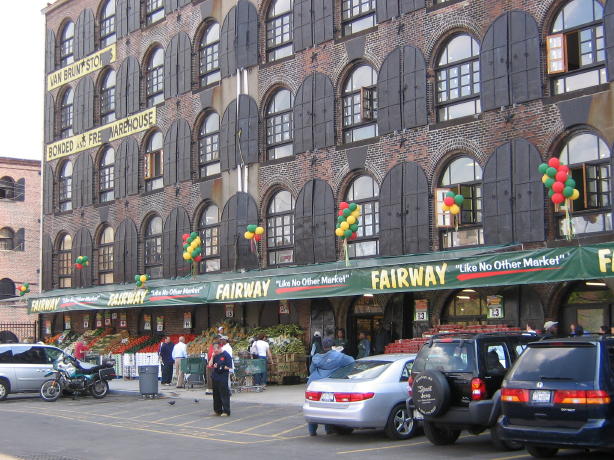
A Big Beautiful Brooklyn Box...Fairway Opens in Red Hook


After months of anticipation, we went to the new Fairway that opened in Red Hook, Brooklyn today. Yes, it is huge (52,000 sq. feet) and filled with a multitudinous variety of fresh and prepared foods, including produce, meats (they even have an aging locker for steaks), seafood, cheeses, coffees, beverages of every sort (with an alcohol level below 6%), a bakery with everything from baguettes to bagels, a staff friendlier than Japanese airline flight attendants (impossible?!), and low, make that LOW prices!

We compared and found that many of our staples, e.g. Tropicana Ruby Red Grapefruit juice, Haagen Daz ice cream, Farmland Skim Plus, and Sauders Organic extra large eggs were all anywhere from 50 cents to $1 less than Key Food or Met Food.

Last night at a sake tasting at The Good Fork we heard that the Grand Opening will be Monday, May 22. Mayor Bloomberg is expected to preside at the ribbon cutting ceremony. Yes, this SUPERmarket is literally a BIG deal! It brings more jobs to what was until recently an underdeveloped area. A few years ago, unless you lived there, Sunny's (or Johnny's as this quirky bar is sometimes known) was the only reason outsiders ventured into this former warehouse-fraught area on the southern Brooklyn waterfront. Now, with the new Cruise Line Terminal and the impending opening of an IKEA, the once modest local economy will get a welcome boost and consumers are winners too.

Getting to the new Fairway might be a bit of a trek for all but those who live in Red Hook. But, with parking for 300, the variety, prices, and quality are sure to draw many more shoppers from a wider area....us included!

Thursday, May 11, 2006

Japan's Hottest Hot Pepper


While wandering through Kyoto's Gion District, we bought this small envelope containing "Japan's Hottest Golden Hot Pepper" at Gion Ajikou. Although we'd never heard of the shop or this pepper, the label on the package saying "Japan's hottest pepper," was irresistable. Always seeking a challenge and, to improve our "spiciness tolerance," we bought it. And besides, Japanese cuisine is not known to be spicy we thought, so how spicy could it really be?

This particular powdered pepper is made from a Japanese yellow or "Ogon (golden)" pepper and it is claimed to be 10 times hotter than regular Japanese "Togarashi (red)"pepper. The Ogon pepper is thought to have originated as a yellow hot pepper in Southeast Asia, and its cultivation in Japan was first recorded in the mid-18th century.

Yesterday, we finally opened the envelope for the first time since our return to NY and inside found the innocuous-looking yellow powder. When the mere scent of that "powder" hit our noses, we began to sneeze violently. We dipped a moistened finger, ever so slightly into the powder and gingerly touched it to our tongue....

...which immediately began to blister! The capsacin level was off the chart! If you, like us thought that Habanero was the benchmark for ultra-hot, Ogon sets a new standard. How to use our "lifetime supply" of this hyper hot ingredient? Some suggestions....how about substituting it for the cayenne in deviled eggs? Use it in lieu of the aforementioned Togarashi in kinpira (gobo or burdock sauteed in grapeseed oil, sugar, mirin, and sake), or maybe in spicy fried rice, or in rubs and pastes for grilling.

Ordering this may be a challenge if you haven't brushed up on your Japanese lately...the website is entirely in Japanese. If you're interested in getting your hands on some, let us know!

Wednesday, May 03, 2006

Ho Chi Min City, Vietnam

We left Tokyo on Valentine's Day to continue begin the second phase of our two-month journey in Southeast Asia. Our first stop was Ho Chi Minh City, Vietnam. Over the next 10 days, we had planned to travel from south to north leapfroging from HCM to Hue and then on to Hanoi before leaving the country for Siem Reap, Cambodia. You may be wondering why there are no photos with this blog...The reason is that, unfortunately, on our last day in Hanoi, our camera was stolen, so sadly, we have no pictures of Vietnam....

Ho Chi Minh City was chaotic and busy. It was such a shock going from orderly Japan to disorderly Vietnam. With thousands of motorcycles clogging the streets, traffic lights were a rarity in this city. Something as simple as crossing the street took some time to learn...you don't wait for traffic to stop or run, just walk VERY slowly and they all drive around you! Once you get to used to it, suddenly you find an order amidst the chaos.

For food, we needed some time to get adjusted, too. At first, nothing at the food stalls on the street looked sanitary, so we were very careful where we ate (mostly in restaurants). We didn't want to risk eating on the street or in the market and get sick. So, we (regrettably, now) didn't try any street food in Ho Chi Minh.

This is not to say that we didn't try to eat any delicious authentic Vietnamese food there. We did. We found a great pho (beef noodle soup flavored with star anise) at Pho 2000 near the Ben Thanh Market and Ham Nghi street. Pho 2000 is a chain restaurant, but it was soooo good. Another popular place Pho 24 is a chain pho cafe, but we found Pho 24's eponymous dish to be not nearly as flavorful as Pho 2000. 2000 is constantly crowded with tourists as well as locals (go to the second floor, it is air conditioned). We learned about the second floor AC on our second visit and there too we saw photos on the wall of Former President Clinton as he enjoyed his Pho 2000 experience.

We also loved the food at Quan An Ngon near Dinh Thong Nhat, the former presidentilal palace. This place seemed popular dining place among young Vietnamese. When we arrived at the restaurant, people were flooded outside of the restaurant, and we didn't know if there was a waiting list or if people were just hanging out. We wedged our way through the crowd to the inside of the restuarant to see if there was a waiting list. The crowd inside was equally as dense and we were told to wait. So, did. Uncertain as to whether they had understood us, we continued to wait in anticipation of something worth tasting. Luckily, we were seated in less than 20 minutes. Sure enough, the food was fantastic, the best (outside of the pho) that we had eaten in HCM! We had lotus salad with shrimp and pork, a shrimp and sweet potato pancake, sticky rice with pork and Chinese sausage, spring rolls with shrimp and pork, grilled beef with toast and chili salt....all very authentic Vietnamese dishes served in a stylish outdoor garden setting (with beers) at a very reasonable 175,000 VND ($12 US)!

Quan An Ngon
138 Nam Ky Khoi Nghia
8257179

Tuesday, May 02, 2006

Nozomi Bullet Train and Ekiben

After spending almost one month in Japan, it was time for us to leave for Southeast Asia. To reach Narita Airport (outside of Tokyo) in time for our flight to Ho Chi Minh City, Vietnam that evening, we took the Nozomi Shinkansen (bullet train) back across the country from western Japan.

Nozomi is the fastest train among all Shinkansen (bullet trains). Nozomi, which means "hope" is faster than the train named, Hikari which means "light" so, that may give you some idea as to how fast it is. With an average speed of 261.8km/hour or164mph, it's route begins in Kyushu (southwest Japan) and ends in Tokyo (
map). Since the Shinkansen rail service does not run through Shikoku, we needed to make a connection with it via an express train from Matsuyama to Okayama. Our Nozomi departed Okayama at 12:06pm and arrived in Tokyo at 3:30pm, less than 3.5 hours to traverse the entire country!

A train station in Japan is nothing like its American counterpart. In fact there is no comparison when it comes to both the quality of food and the number of purveyors. At the "eki" there is always an irresistably aromatic bakery, as well as numerous shops selling bento (boxed meals), noodles (ramen, udon, soba), souvenirs (or "omiyage," the all-essential gifts brought back for friends and family by Japanese travelers), and kissaten (coffee shops that offer amazing coffee, baked goods, and light sandwiches). Hard as it may be to imagine from our own experience in the US, in Japan, the train station is a gastronomic fantasyland!

A train trip without "ekiben" (eki=station and ben=bento) is like a visit to New York without eating bagels. If you have never had the ekiben experience, you really must try it at least once. Since train travel is the most popular (and easiest way to get around) in Japan and the Japanese have grown up eating bento since their childhood, it was natural for the culture of ekiben to develop. Each region's ekiben features their own unique and local specialities. This self contained meal is a great value too, costing ony about $5 to $7. Each comes complete with chopsticks, soy sauce, napkin, and of course, a tooth pick (a hopitality fixture in Japanese dining).

It is quite easy to understand the attraction to traveling by train in Japan. The rail system is pervasive and ALWAYS on time. The stations are monuments to cleanliness, organization, efficiency, and most importantly, the place where great food is found at every turn. It's no wonder that every inter-city passenger seems to carry an ekiben with them when they board, no matter what the time of day! We were delighted that our Nozomi experience allowed us the time to indulge ourselves in ekiben, a quintessential source of pleasure that exists only in Japan!